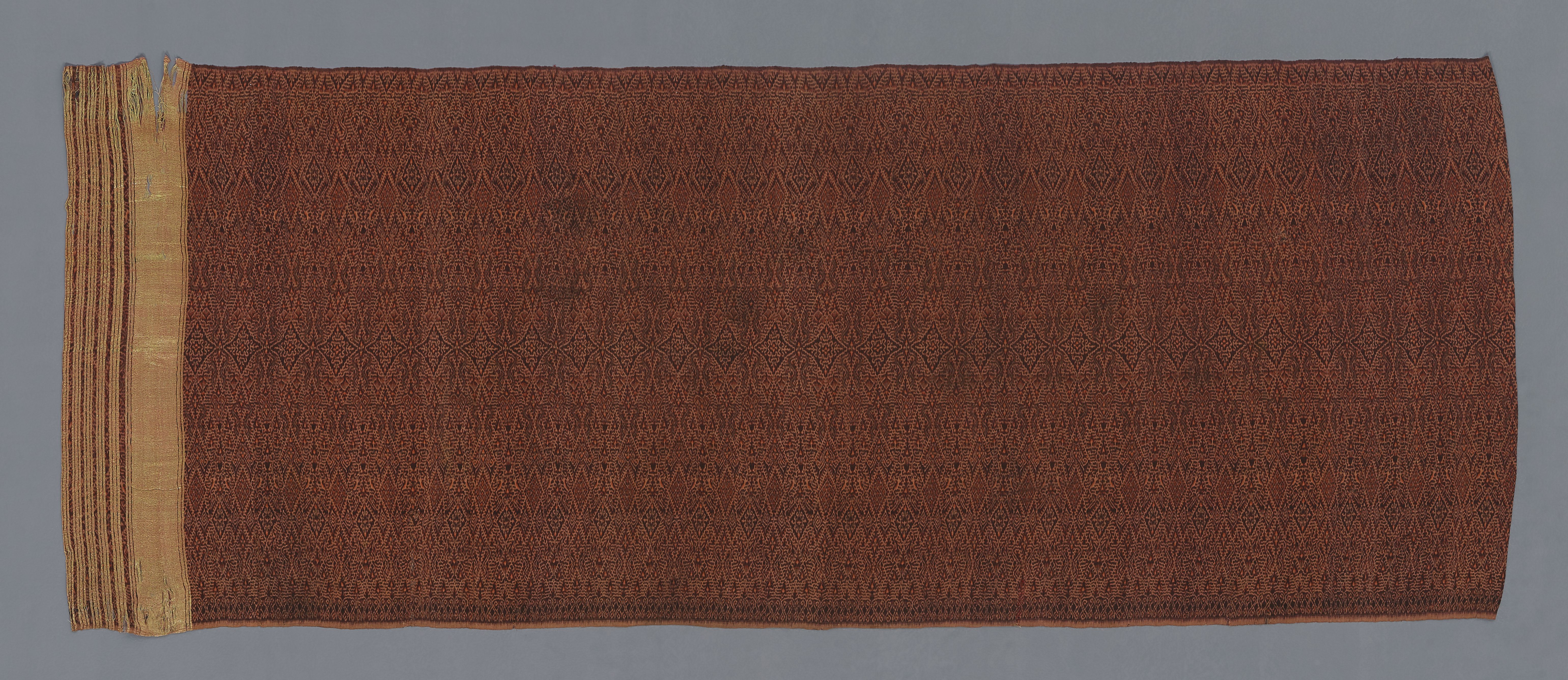
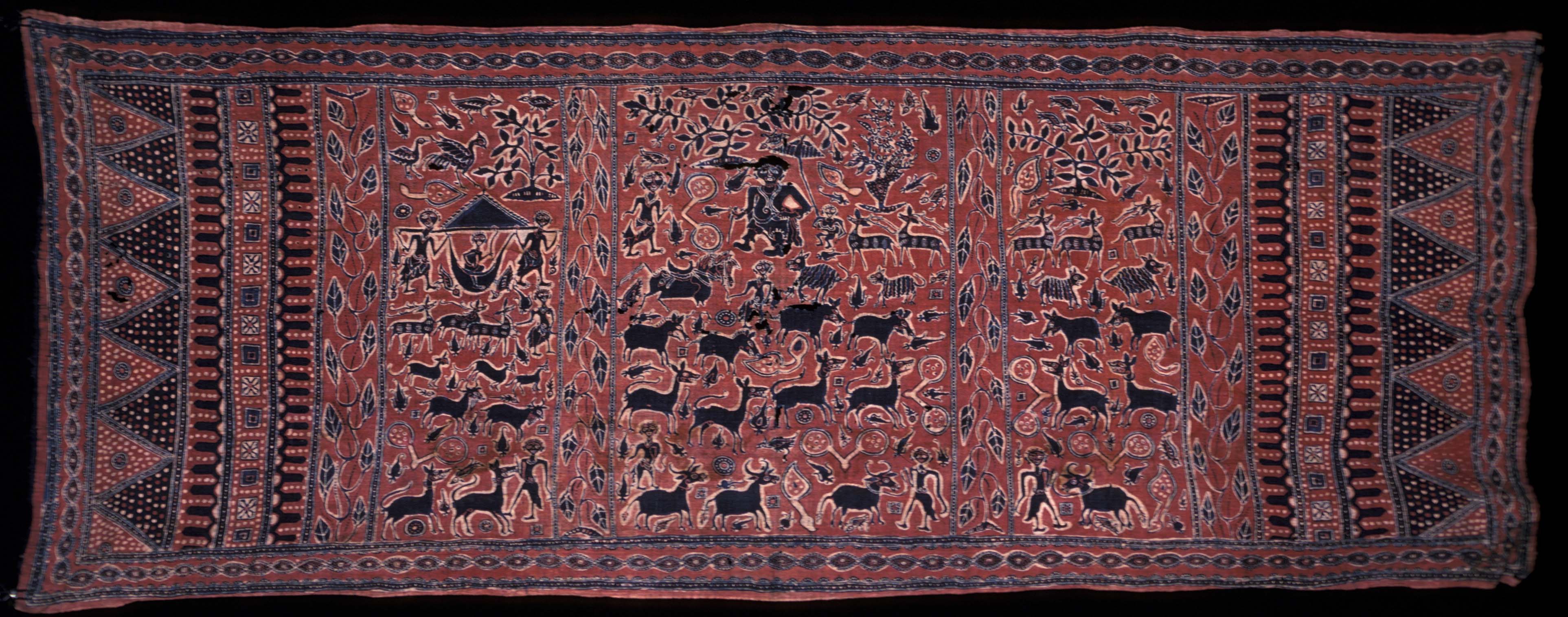
A fascinating old textile of hitherto-unknown type (Color Plates 2a and 2b), recently located, raises unsettling historical questions about several important Indonesian textile genres (geringsing, dodot) that specialists – despite many misgivings, but in the absence of contrary material evidence – have long considered to be purely local-Indonesian in conception.
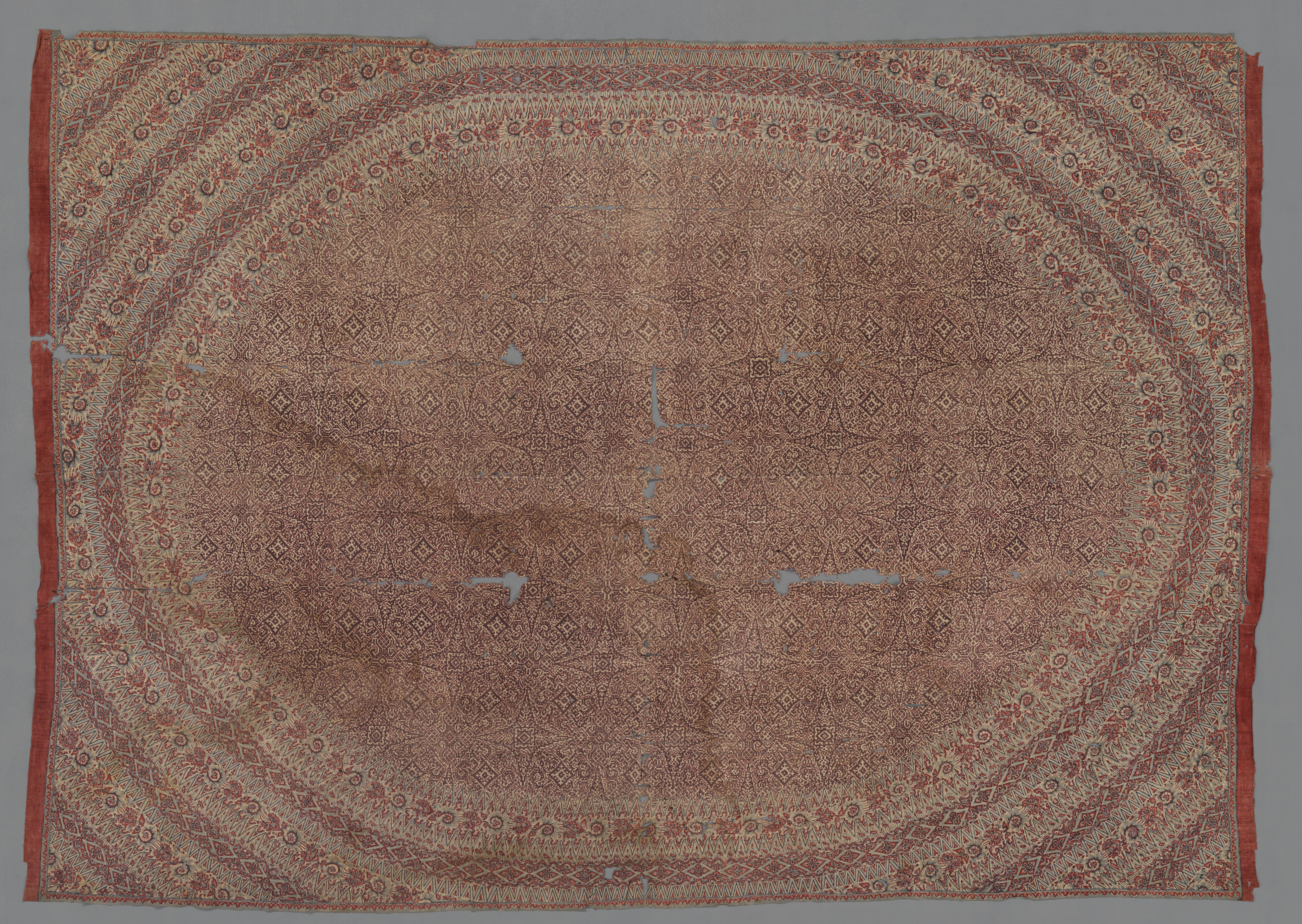
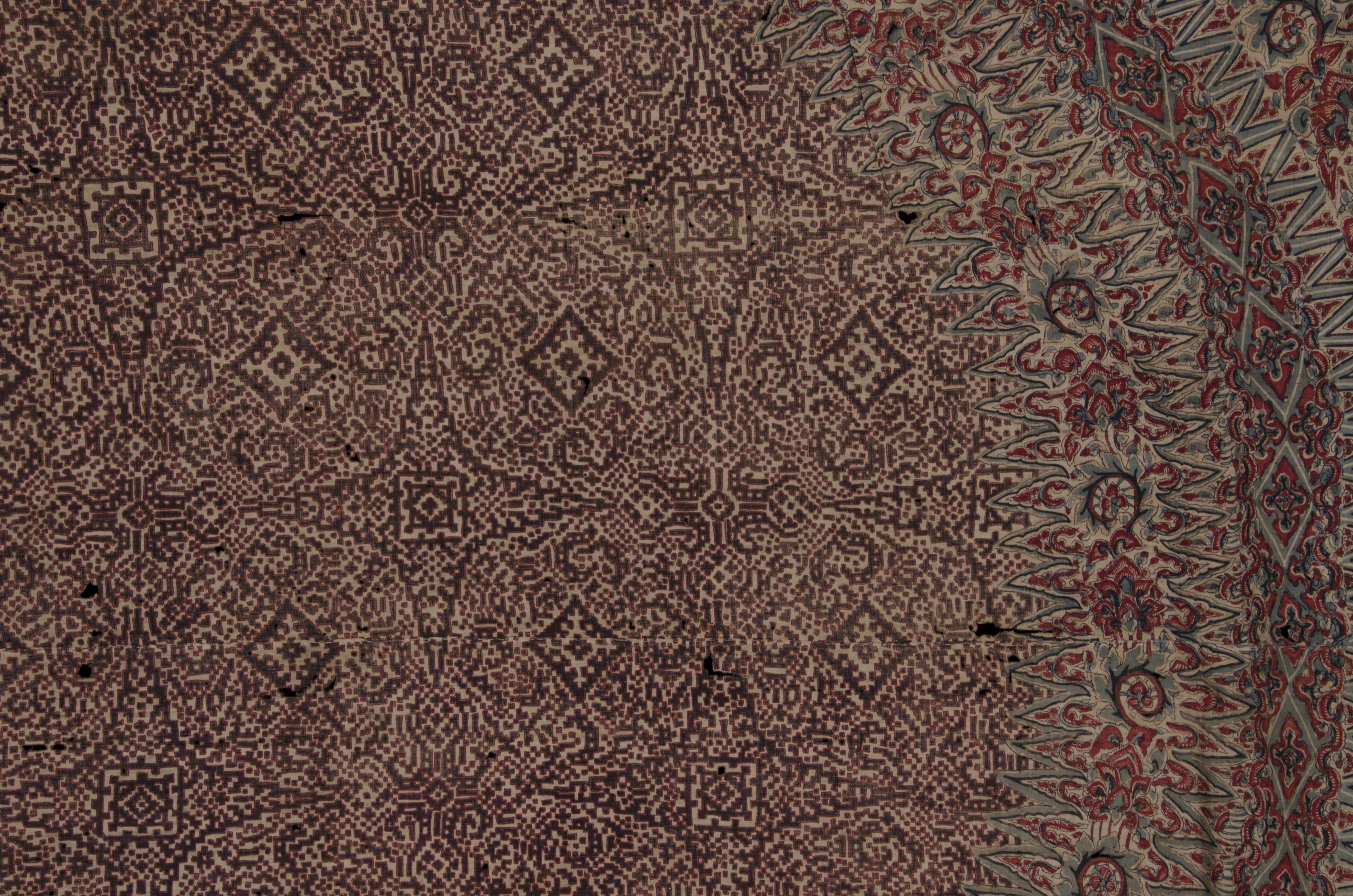
The textile is manufactured on handspun cotton of medium quality and thread count, patterned on both sides in an array of common kalamkari resist-dye techniques. Its probable date is mid-eighteenth century. Important features are large size (322 x 225 cm), Sumatran (south-coastal Lampung) provenance, dodot-like organization, deliberate imitation of the visual appearance of double ikat, and a huge geringsing main pattern field à la Bali.
This cloth is not unique. A substantial number (40-50) of closely related textiles located also in south-coastal Lampung possess similar size, shape, quality, materials, dyes, and techniques (e.g. Color Plates 1-4, 8).
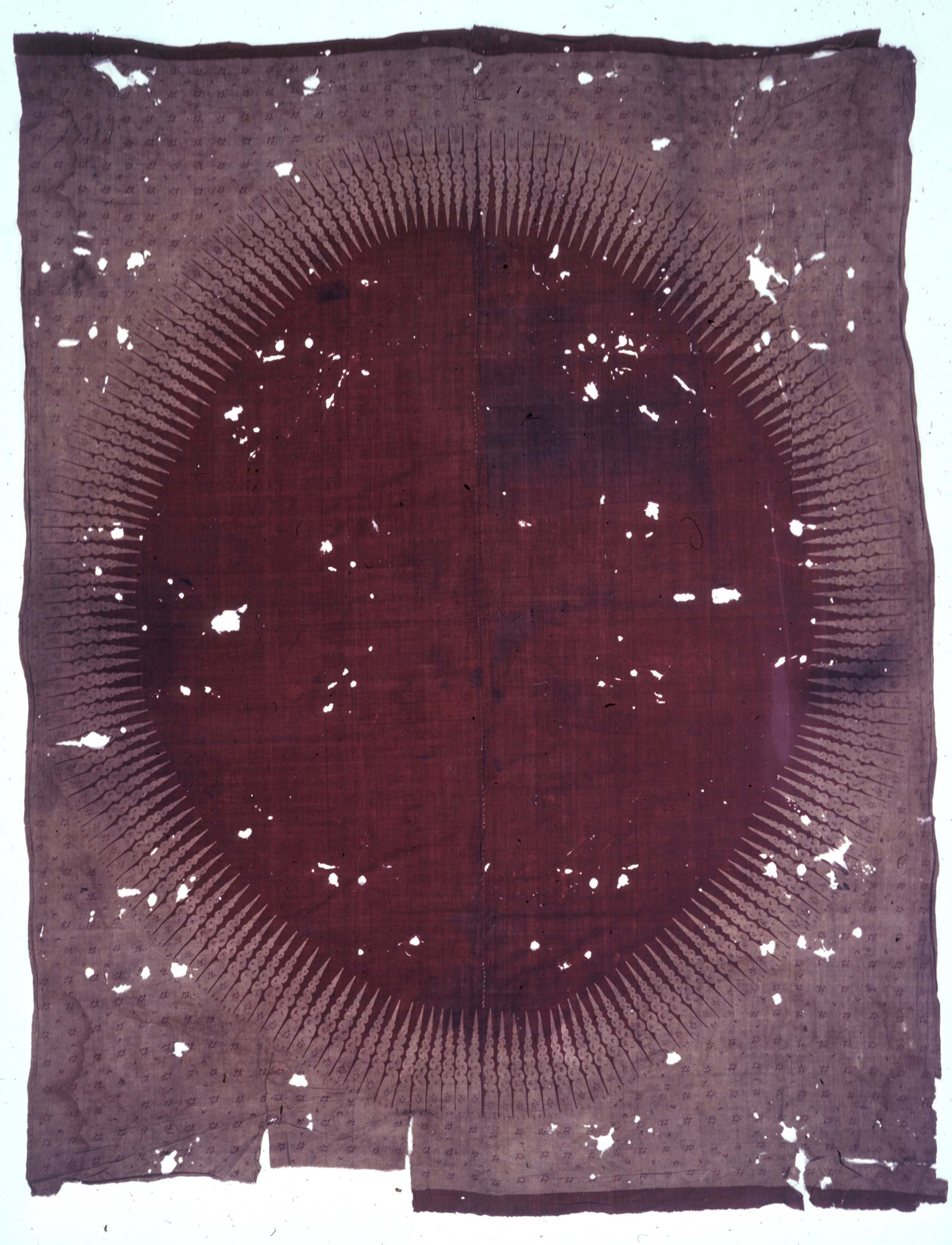
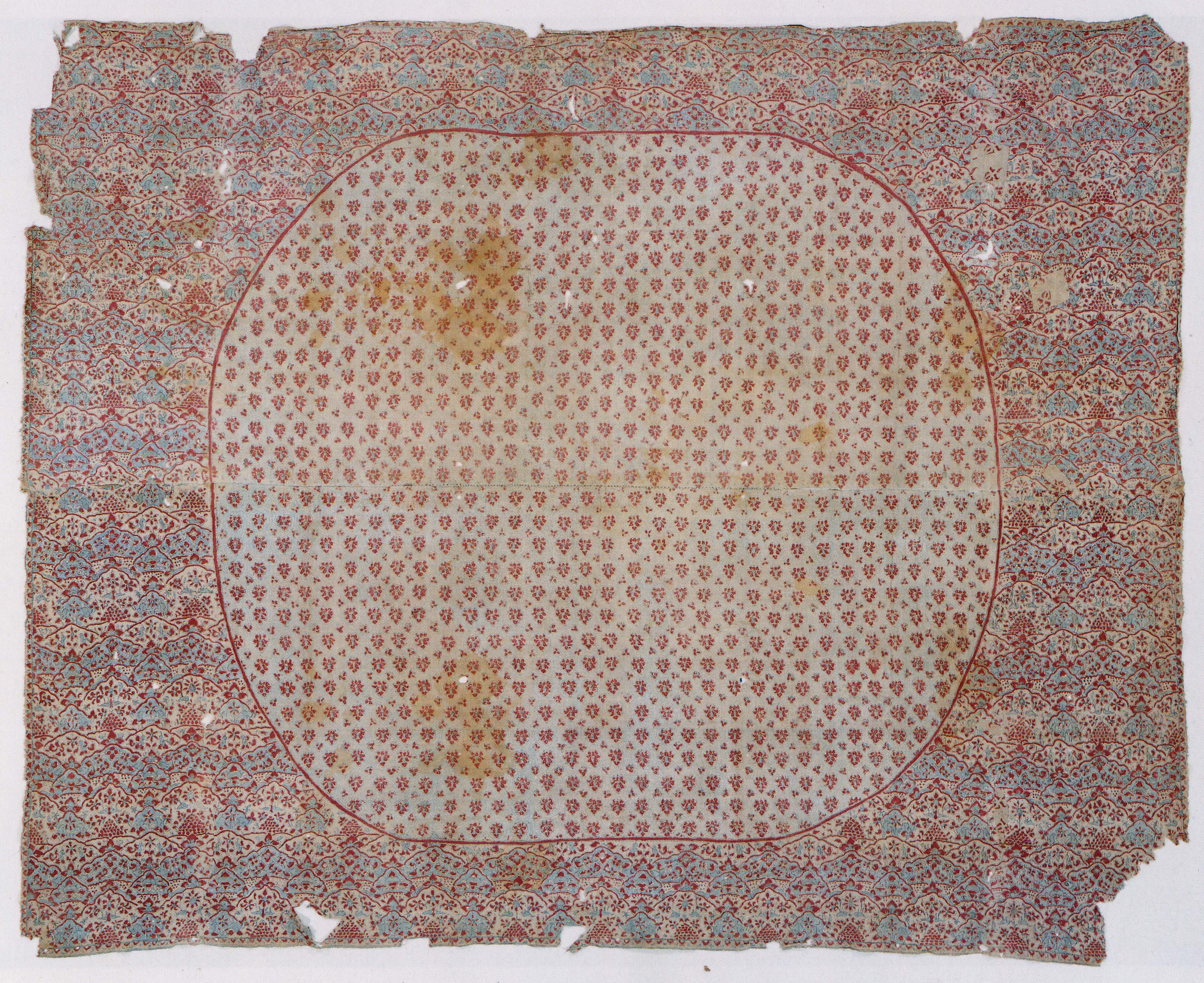
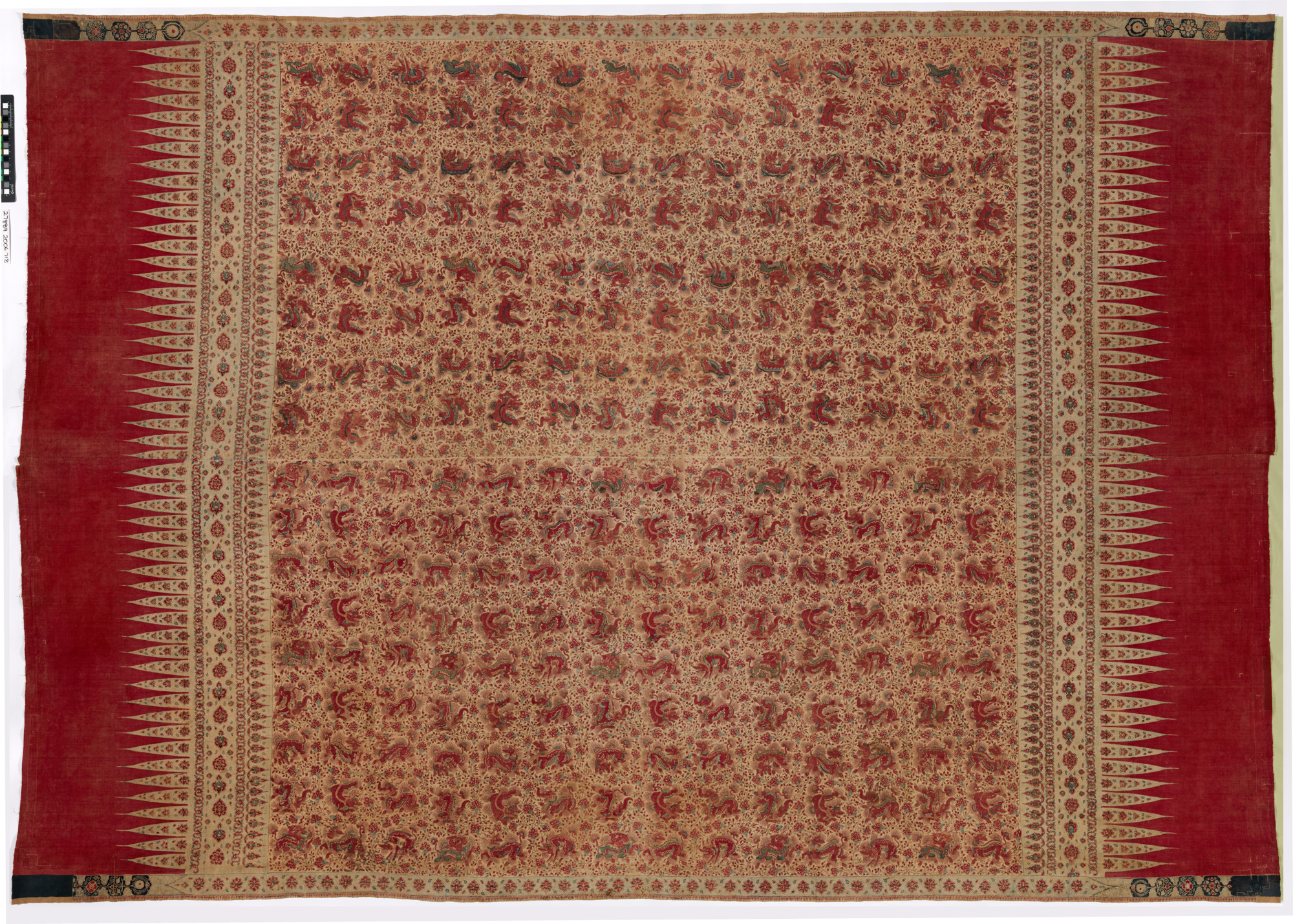
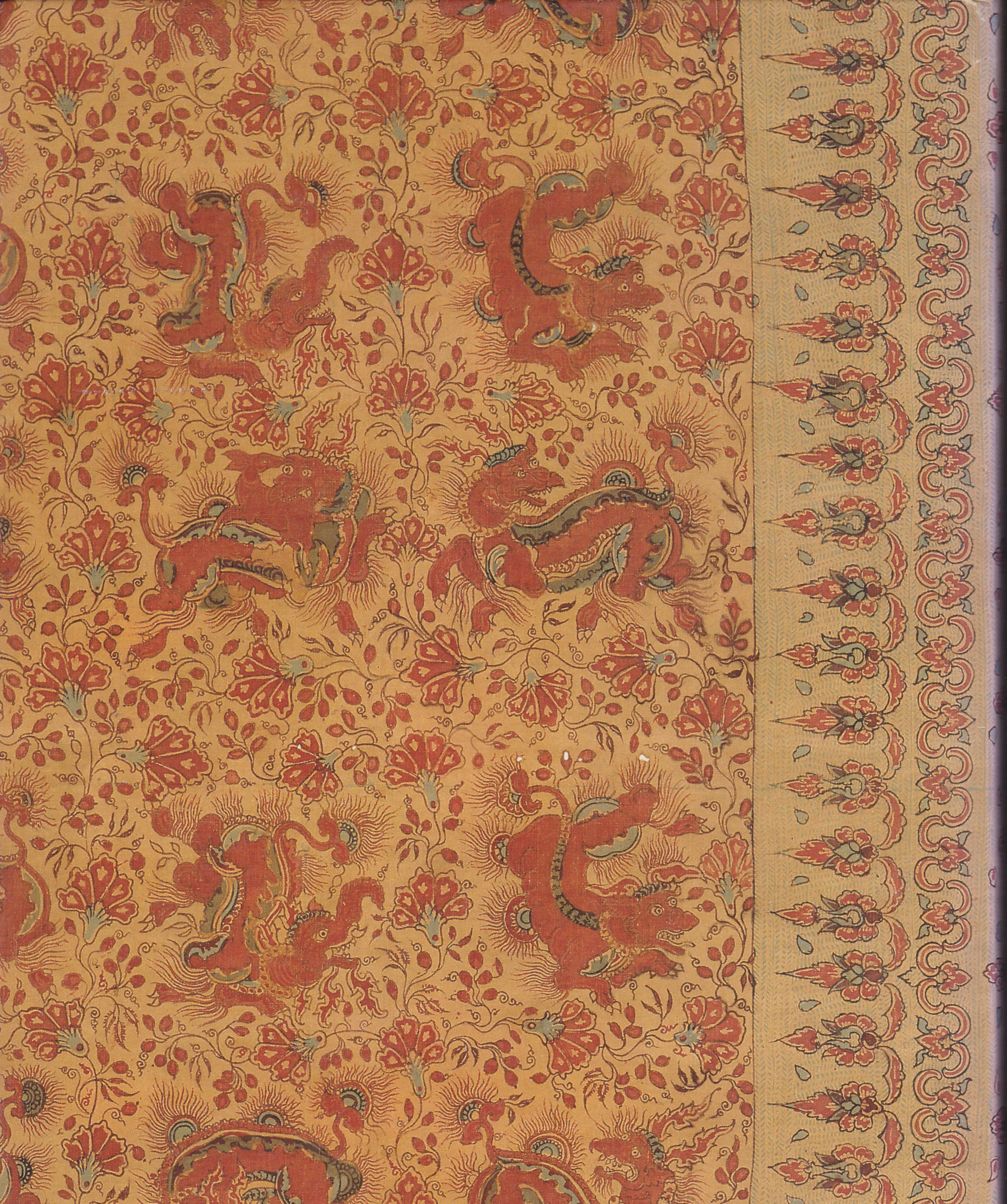
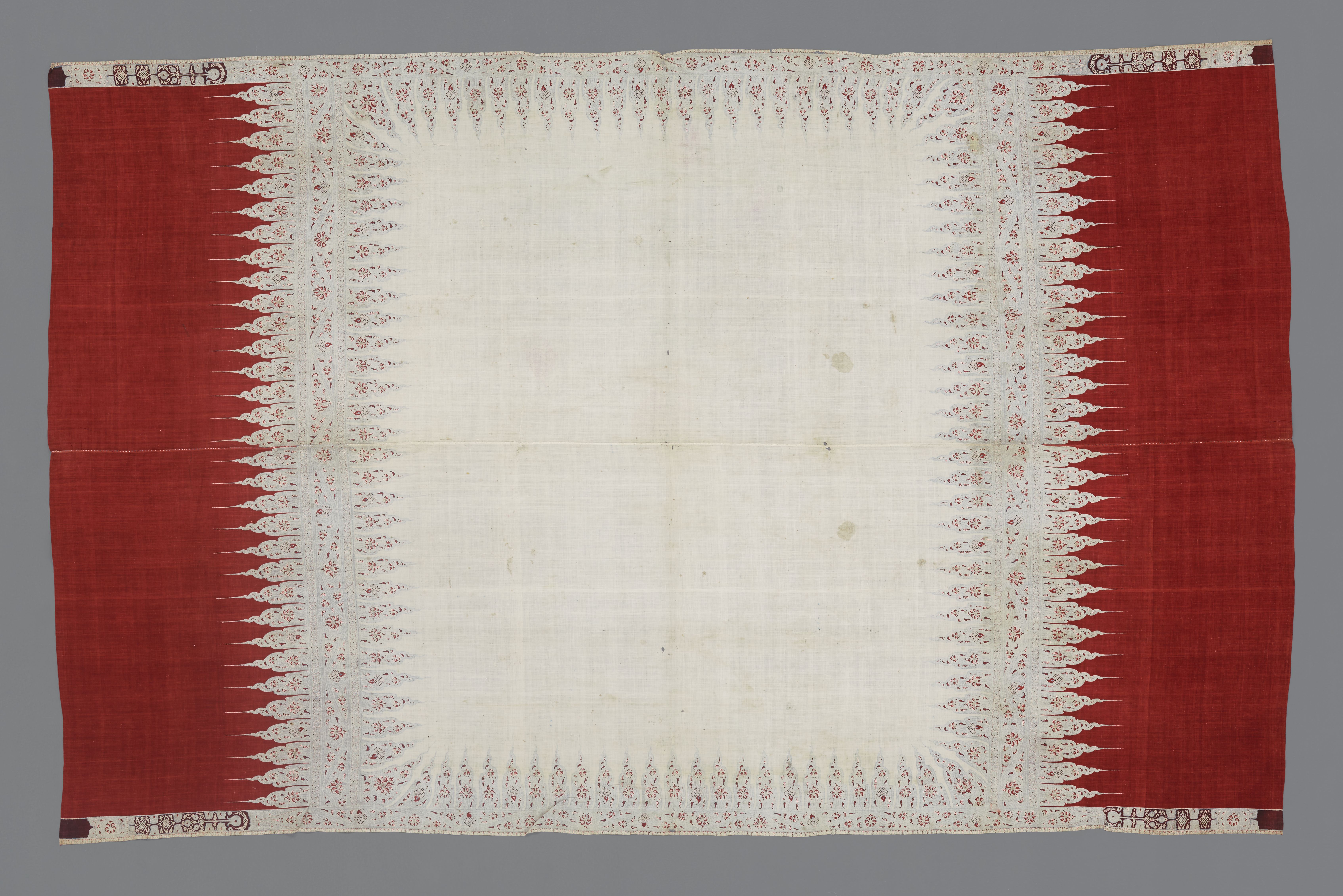
In several cases, they bear VOC stamps. Like Color Plates 2a/b, most but not all of these cloths are composed of two sections of fabric sewn together longitudinally. Many are fragments, which have suffered catastrophic damage. Despite considerable variety in pattern, all of these pieces show signs of a proximate place and date of manufacture. Although we consider alternative (southeast Asian) hypotheses for the provenance of these textiles (see note 85), we conclude that they belong to the class of India-made fabrics called kalamkari, sarasa, pintado, etc (hereinafter termed “chintz”).
The present genre (here termed “Lampung chintz”) is known in Lampung as lelohor or leluhur. The root word lohor (Jav. luhur) embraces rich associations: midday, the meridian; exalted, noble, aristocratic, sublime; leluhur, ancestors, poyang. According to an experienced local (but not ethnic Lampung) informant, lelohor were hung on walls and (especially) on ceilings; they are associated with the sky. We have no present indication that they were ever worn in Lampung; however, our field information is third-hand, and apparently derived from a few south-coast noblemen.
Direct comparison with verified Indian chintz strongly suggests that this entire group of textiles was made in India. Because Lampung chintz display many overall patterns and individual motif elements subsequently cultivated by Javanese/Cirebonese batik (circa 1775 onward, i.e. in the historical pieces that survive), but not widely employed – insofar as we know – in India, it is likely that Lampung chintz were made specifically for use in Indonesia. A high degree of specialization is evident, i.e. they may have been produced solely for the locality in which they are now found. ‘Export chintz’ recovered further east, in Bali, Celebes, and the Lesser Sunda islands, are entirely different in pattern, shape, local function, and quality.
Large parts of the Javanese batik (especially “pasisir”, north coast) repertoire executed during the nineteenth and twentieth centuries relate iconographically to seventeenth and eighteenth century Indian chintz. This circumstance, together with the close technical relationship between the two genres, suggests the possibility that chintz and batik are related parent and child processes. There is considerable evidence, both concrete and circumstantial, which supports the theory that batik derives from chintz, and relatively little resistance; but proof is elusive. Few batiks are dated with confidence before AD 1800, whereas chintz production rapidly declined in quality, quantity, and relevance to batik after 1800: thus chintz and batik cannot be compared during the presumed period of their greatest interdependence because we lack batik examples. Moreover, pre-colonial chintz (before AD 1600) are only intermittently available outside southeast Asia (see page 60), while inside pre-colonial southeast Asia the ‘look’ of sophisticated chintz or batik (if the distinction was formerly valid, see note 6) is entirely speculative because no visual record of either genre survives.
Sixteenth-century Portuguese reports indicate the presence of chintz in southeast Asia, Balinese kidung literature arguably establishes chintz in the archipelago during the fifteenth century, and archaeology in fact reveals chintz in mainland Asia at the beginning of the Christian era (see pages 60ff). However, to our knowledge the word batik is undocumented prior to the first half of the seventeenth century (raising a possibility that Indonesian batik did not exist before the sixteenth-seventeenth century, or alternatively that it was known by another name. The earliest surviving pasisir batiks (e.g. circa 1775 from Cirebon, where pasisir and central Javanese styles were bridged) display many more foreign (Chinese/Indian) features than later pieces. After 1800 batik drew progressively distant from foreign connections, and developed individual styles not found outside Java: the pasisir's increasingly hybrid and berisik [noisy/tumultuous] pot-pourri, central Java’s ineffable intimacy.
The idea that batik originates in its entirety in India, as powerfully argued by Rouffaer and suspected by many textile specialists, but generally shunned by Indonesians and Indonesianists, cannot be dismissed.
The chief rebuttal to this ‘Indian origin’ theory is central Java, which favors some batik patterns seemingly unrelated to Indian chintz. Nobody yet knows when or how central Javanese batik began; but the deep well of feeling that central Javanese reserve for their arcane soga cloths, and the philosophical nuance which they apply to interpretation of patterns, offset the absence of documentary evidence for batik’s antiquity and tend to weigh heavily in any assessment. Batik tradition seems to hold an ancient and honored place in the Javanese consciousness.
Lampung chintz – a ‘new’ factor – need to be accounted also. Like Cirebon batiks (page 67), they link pasisir and central Javanese batik to ostensibly Indian products. Lampung chintz exhibit mainstream attributes of batik from both the northcoast and the Principalities. They spur a review of old questions about the sources of Jawa pasisir/central Javanese batik iconography. If some of the cherished patterns of central Java did appear first on Indian or other imported products, then we wonder whether Java’s “deep well of feeling” might have been devoted, long ago and originally, to foreign goods with compelling meaning or appeal for Javanese.
Lampung chintz seem to have been made specifically for Indonesia, in an incontestably commercial environment. While chintz occasionally depict patterns with ‘philosophical’ or religious implications (Trees of Life, Ramayana scenes, etc.), it is safe to say that, during the (extant evidence) period AD 1600-1800, the Indians and Europeans who shipped these cloths to southeast Asia in staggering quantity were neither philosophers nor mystics but entrepreneurs seeking profit. By contrast, Indonesia’s attitude toward chintz included magico-religious sentiments in many regions (e.g. Toraja); some groups attached elite prerogatives to their use (the evidence of Lampung is that chintz were preserved to the present day, and probably originally possessed, only by traditional nobles). We take these diametrically opposite Indian-Indonesian perceptions of chintz as a warning, not to settle the horse-and-cart issue hastily, and to seek an earlier, less jejune, more spiritual context for the dissemination of potent, inspiring images.
The basic historical questions are: If there is a parent-child relationship between chintz and batik, then where was it made first – who started it? Why were some chintz produced only (apparently) for Indonesia? Were ‘Ur’-versions conceived/pioneered in Indonesia during ancient times, and subsequently ‘improved’ in India for Indonesian consumption, thereby superseding and obsolescing – or possibly supplementing – the original Indonesian manufactures? Or, are they ancient Indian patterns which fell from fashion in India, while demand persisted in Indonesia? Were these chintz originally executed in other media, e.g. patola, and later replicated in cheaper batik/chintz form for provincial consumers? Is it possible that ‘offshore’ factories were established in southeast Asia, which produced some chintz for specially-targeted markets? The answers certainly lie prior to 1600 – but how much earlier?
Very early Indian chintz and wax-resists do exist. The ‘Fustat’ textiles recovered from Egyptian necropoli yield innumerable visual comparisons with export chintz found in Indonesia (Toraja mawa’ of Indian origin are sometimes identical in every observable respect to Fustat finds. One problem with the plentiful Fustat material is that dating of many individual pieces is disputed (thirteenth-seventeenth centuries AD); some, however, were removed from sites (e.g. Qushayr al-Qadim dating to the beginning of that period.
Recent Chinese archaeological discoveries push the chintz chronology further back, to the Eastern Han dynasty (AD 25-220). From Niya, an oasis in Xinjiang, an indigo and natural cotton wax-resist fragment displays a standing Buddhist deity (his toes only and a lower corner of his framed space are preserved). A rabbit(?) bites an undulating serpent on the tail in a register beneath this deity; to his side a smaller, thoroughly-Hellenized male bust with nimbus (the only complete image that survives on the fragment) holds a cornucopia.
Stylistically, this textile belongs to the Kushan period, circa second-third century AD. It might have been made almost anywhere in India or its hinterland, e.g. in Bactria, Sogdiana, or central Asia. Though examined in photographs only, this Niya fragment appears closely related to techniques, materials, and ornamental mannerisms of Fustat and many Indonesia-directed (e.g. Toraja) ‘export chintz’, despite an interval of more than a thousand years.
Similar batiks with Christian iconography, circa fourth-seventh centuries AD, have been found in Egypt; they have features entirely characteristic of later Indian chintz and, in several instances, of central Javanese batik (Tacitus and Pliny several times refer to the fame of Indian cloth, the grossly unfavorable balance of payments with India, and outrageous Indian profiteering on textiles and plant-products, even to the point that Roman coinage was debased: “such is the cost to us of our exquisites and our women” ). From the other end of Asia, the Shoso-in and Horyu-ji treasuries (Nara, Japan) preserve seventh-eighth century AD batiks with a Chinese/Cirebon flavor. Iconographically, Shoso-in and Horyu-ji textiles are almost totally derivative of mainland Asia (both west and east); but if Matsumoto’s opinion that most of these textiles were manufactured in Japan is correct, then these treasure houses show that iconography, techniques, and materials (and probably craftsmen as well) were traversing the entire continent at this date. We suspect that similar transmissions had occurred since at least the end of the first millennium BC – in other words, that the ancient Asian world was far more integrated and interrelated than scholars commonly imagine. Most important, the level of Shoso-in/Horyu-ji craftsmanship and quality, the range of technique and imagery, is staggering (this, in the ‘isolated’ Japanese archipelago, at the edge of the known world).
Another batik fragment, from a Byzantine site in Egypt circa sixth-seventh century AD, displays a border pattern seen identically on Toraja mawa’ and many other Indonesia- directed export chintz. The mainfield is ceplok (geringsing Figure 1 belongs to the ceplok family of patterns; so do Shoso-in fragments.) The list of suggestive similarities is long.
These remnants underscore the danger of arguing only from existing evidence, without considering evidence which has disappeared (a strong susceptibility among Indonesianists, who often treat cultural history as if it began in the Javanese Imperial period circa eleventh century AD, when documents begin to accumulate). In the absence of concrete admonitions like these early fragments, one might readily – but wrongly – conclude that chintz arose in the fourteenth or fifteenth century. We consider now other ‘missing’ textiles.
The geringsing chintz (Color Plates 2a/b) drives to the heart of issues mentioned in previous forums, viz., the impact of prototype textiles in ancient Indonesia, and the relationship between similar iconography that appears in foreign (Mediterranean, Near Eastern, Indian, Chinese, etc) and Indonesian products.
The term ‘prototype textiles’ here denotes several hypothetical weaving genres, probably of non-Indonesian manufacture, which circulated throughout the western and central portions of the Indonesian archipelago and mainland southeast Asia during pre-colonial times. For reasons that remain conjectural (see pages 68ff below), these prototypes decisively influenced the visual preferences and motival ‘vocabulary’ of local textiles in Indonesia and other recipient cultures. At particular historical moments, availability and distribution of these prototypes was suspended or terminated, and consequently – for reasons of habit, the evolution of domestic or ritual necessities, prestige associated with patterns and genres, color and dye qualities, etc. – the recipient Indonesian cultures manufactured local versions of those prototypes, using available materials and techniques. Gradually, as copies copied copies, local reproductions acquired their own life, and often were overlaid with idiosyncratic characteristics of each local ethnographical culture that made them. In time (± 100 years), most physical specimens of original imported prototypes disappeared, their precise appearance became an increasingly dim memory (their true significations perhaps never comprehended), and wide variations on the original theme often crept into copies made in disparate locales.
Several facets of the construction of chintz Color Plates 2a/b suggest that it derives, at least in its central oval section, from another textile genre, probably executed in the double-ikat technique. In other words, this type of chintz does not represent the original model for Balinese geringsing. Rather, it is a very late (probably eighteenth century) and inexpensive copy of some earlier prototype.
The chintz’s geringsing pattern is described with stepped right-angles ▚ deliberately drawn, an obvious attempt to replicate the visual effect of double ikat (see detail, Color Plate 2b). To jump from observation to inference, doubleikat facsimile, frequently encountered in both Indonesian textiles and Indian chintz, probably indicates that an earlier prototype textile was executed in the double-ikat technique (stepped right-angles in Javanese batik, for example, virtually always signify a patola source). Although this might be a commercial deception (to ennoble common textiles by association with prestige patola/geringsing features), more likely double-ikat facsimile reflects the sacral, almost superstitious attitude of Indonesians toward cherished original prototypes: consumers demanded that reproductions be as faithful to the originals as means/techniques would permit – and the originals were double-ikats. The pattern that appears on geringsing chintz Color Plates 2a/b was still sufficiently popular in seventeenth-eighteenth century Indonesia to be profitably reproduced by Indian dyers (in this case, for Sumatran clientele).
It is extremely unlikely that provincial Bali was the original source or center of this geringsing chintz pattern. In the main, Balinese textiles are significant art-historically as hinterland reflections of the enormous inventory of patterns/prototypes which, properly, pertain to the India- Hindu-Buddhist period centered in Java and Sumatra – with pasisir outposts in Malaya, coastal Borneo and Celebes, and the Lesser Sunda island chain (Bali eastward). Although sometimes very rare, relatives of almost every Balinese textile category can be found somewhere else in the western archipelago (not unexpectedly, Lampung, Bengkulu, Palembang, Minangkabau, and Malaya are the most important regions for related weavings).
The dark-brown geringsing patterns of this chintz are everywhere highlighted with red lines around the edges (see detail, Color Plate 2b). These red lines (imperceptible except at close range) operate almost subliminally to enliven, brighten, and clarify an otherwise sober brown-on-taupe field. Interestingly, similar transitional red ‘lines’ occur also on some Balinese geringsing, where Morinda citrifolia red, normally overdyed upon an indigo ground to obtain brown, is applied slightly beyond the margin of indigo and penetrates undyed natural cotton: the result is brown patterns with red outlines. Although an extremely common effect, many Balinese consider this to signify faulty geringsing dyeing procedure. We wonder. Are the red lines on geringsing Bali and this chintz coincidental, or might they indicate interrelationship – for example, the replication of a feature of a common ‘ancestral’ prototype? Narrow red outlines (Color Plate 2b) occur also in high quality patola, notably where blue or black meet white (a refined detail rare in export patola). The introduction of red outlines in patola is deliberate (separate tying/dyeing), not merely a consequence of imprecise dyeing (geringsing).
Indonesian weavers have a habit of isolating and re-interpreting, according to local values and vision, elements from imported designs. Sometimes the transformed pattern (arbitrarily extracted, dramatically enlarged, filtered through and fancifully embellished by the local eye) is so startling and so different that its iconographic antecedent can barely be traced. To ‘decode’ or ‘read’ such textiles and reveal the source pattern, we need to identify main elements, and discard extraneous ornamentation.
Possible instances of ‘reinterpretation’ occur in Balinese geringsing wayang puteri.
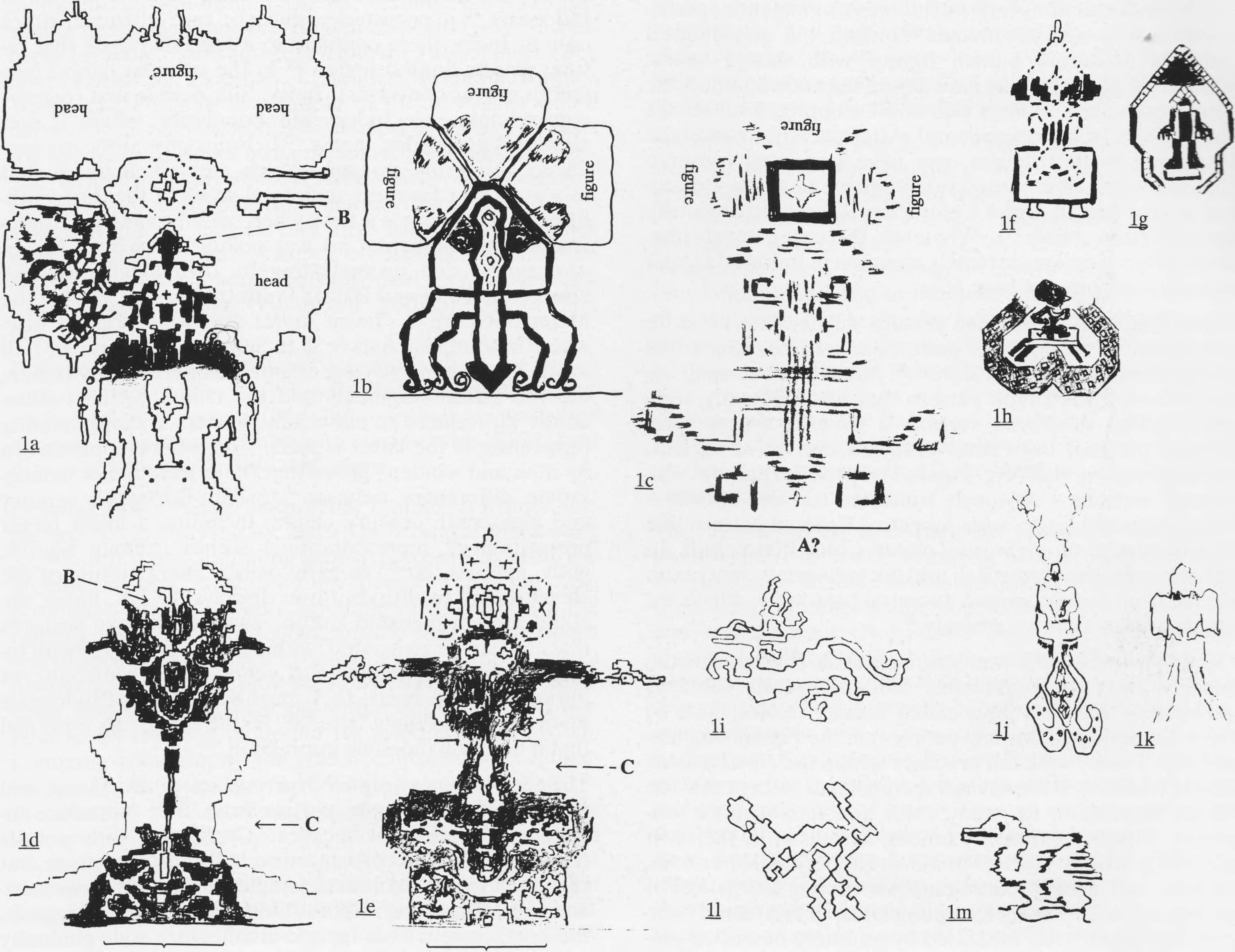 Drawings 1:
a. Center of a Balinese geringsing wayang puteri.
b. Center of a Lampung beaded tampan. Australian National Gallery, Canberra, accession no. 1983.3689.
c. Center of a silk embroidered Lampung food offering cover, after Langewis and Wagner 1964: p l. 203.
d. Motive from Balinese geringsing wayang kebo.
e. Balinese geringsing motif, after Bühler et al. 1975: no. 36. This motif appears between the pillars of Drawing 2a.
f. ‘Enthroned’ figure, from a Balinese geringsing isi.
g. Figure sheltered by umbrella from Lombok (Sasak) pesujutan.
h. ‘Enthroned’ figure, from a Fustat chintz fragment, after Pfister 1938: pl. XXVb.
i. Zoomorph (quadruped?), detail from Color Plate 5.
j. Anthropomorph, detail from Color Plate 5.
k. Anthropomorph, detail from Color Plate 5.
l. Zoomorph (quadruped?), from a Balinese geringsing isi.
m. Zoomorph (bird), detail from Color Plate 5.
For example, four seated Hindu-Javano-Balinese ‘ladies’ are clustered in back-to-back pairs around a central white square. Their heads only are dramatically highlighted against a light ground in each ‘corner’ of the square (Drawing la, one head only is drawn at lower-left; three remaining profiles are labeled “head”).
Several Lampung textile genres display a similar layout, in which however the Hinduistic ladies are absent, while more archaic (‘Old Indonesian’-style) figures appear. For example, a beaded tampan highlights the heads of four anthropomorphs within a central clover-shaped area of prestigious muti sala’ beads (Drawing lb; one figure is drawn, and three more identical images are represented by “figure” labels only). Heads of four similar figures meet in the center of embroidered foodbowl covers (Drawing lc). These Lampung anthropomorphs appear, not at the corners, but in the middle of each side of the central square; they bear no resemblance to the clearly-rendered ladies depicted in geringsing wayang puteri. Lampung’s ‘human’ figure (Drawing lb) has a small head and trunk, disproportionately enlarged genitalia, and long bowed legs. Looking back at geringsing wayang puteri (Drawing la ), what seems at first a mere ornamental backrest or pillar between opposed ladies – a negative space defined by their coiffures, backs, and crossed legs – might be reinterpreted as an anthropomorph.
Fanciful manipulation of negative space, and a chronic inclination to transform void patterns into primary patterns, are Indonesian traits. Viewing unfamiliar material, Indonesians tend to find what they want to see. But the question is, if these Bali-Lampung similarities are due to an historical connection – or if Lampung weavers were copying geringsing Bali – how could Lampungers have overlooked the clearly-defined ladies in the corners, who dominate that textile? It seems more likely that Bali and Lampung weavings copy, not each other, but some common prototype of more abstract geometrical character (~ chintz Color Plates 2a/b, or patolu jlamprang Motif Types [MT] 11 and 12 in the Bühler and Fischer 1979 catalogue), from which each culture extracted and then ‘clarified’/embellished certain visual seeds that generated empathy and recognition. The emergence of human figures, in particular, from abstractions reflects Indonesia’s indigenous preoccupation with ancestor images. Indeed, old ‘genealogical patterns’ featuring human figures with shared heads, limbs, and genitalia may have suggested anthropomorphic reinterpretations in both Bali and Lampung, with results that are similar but coincidental. Alternatively, a prototype displaying human figures may have circulated (observe that the heads of mounted riders ‘meet’ all along the central mirror axis of cepuk Color Plate 7, a textile obviously derived from patola). Whatever the case, transformations of this type are extremely common in Indonesia (for a tampan example, see page 65).
Many localized Indonesian textiles display one or more fragmentary ‘windows’ of pattern, sometimes sliced like peeks through cracks in a wall, other times a small excerpt from a prototype pattern that was originally complete. The windowed version is never a source (prototype) pattern, but rather always a derivative variant. Most geringsing Bali (e.g. Figure 1) reproduce narrow ‘windowed’ sections – obviously truncated top and bottom – from originally large, wide repeating fields of pattern like that displayed on geringsing chintz Color Plates 2a/b. In other words, geringsing Bali and the geringsing chintz both derive from some common ancestral prototype, which the chintz quotes more extensively.
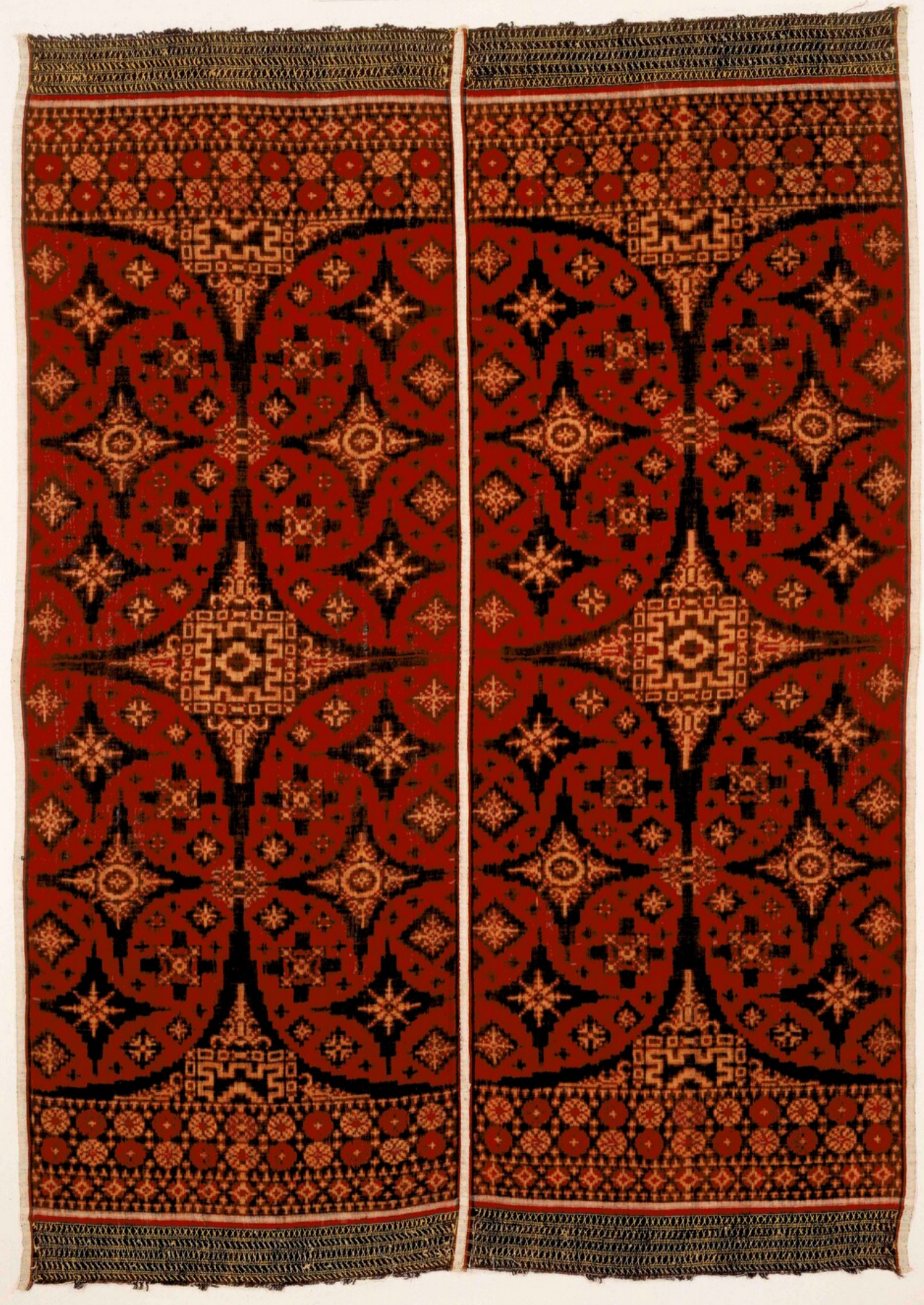
Other evidence from Sumatra buttresses this conclusion, namely, very old (probably mid-sixteenth century) geringsing-like weft ikats called bidak (Color Plate 5) from Komering (Lampung peoples) in the Palembang hinterland.
These bidak fall precisely within the cepuk/pasisir textile tradition in format and arrangement, except that the Malay disposition to gaudy color and flamboyance (encoded, rather pejoratively among Javanists, in the term pasisir) is wholly absent. In bidak Komering, sober reds, browns, and blacks predominate (the precise ikat palette of geringsing and of many Lampung tapis, in fact) amid complex tiny geometrics inhabited by minutely-described animals. These bidak Komering usually have cotton wefts and silk warps; weft ikat of cotton (found in cepuk also) is unusual in Indonesia (a few Komering ikats are rendered entirely in dazzlingly colorful silk). The technical precision, ‘microscopic’ patterning, and gossamer fineness (±33 cotton wefts per cm) of these ikats is stunning, and unparalleled in Indonesian textiles. Most important, their design contains wide fields (not narrow excerpts) of geringsing motives like the chintz under discussion here. Bidak Komering sometimes incorporate bands of plainwoven ‘gold’ gimp at both ends, similar to those found in the pallav of Indian patola (and a feature we have previously observed in Indonesia only on a few Gresik dringin, e.g. Hardjonagoro 1980: figs. 4-5). Intriguing sidelights are that two lengths of bidak Komering were always sewn together on the weft selvedge (like some geringsing breast/waistcloths, e.g. Figure l); and that bidak were used to cover corpses (like geringsing).
However widespread double ikat may once have been in Indonesia, it persisted with vigor into historical times only in India, there confined to a specialist caste that resides in one limited region. In the colonial period (sixteenth century onwards), Indian silk double ikat (patolu) enjoyed immense Indonesian popularity, where it was viewed as a ‘superior’ textile. In Bali a specialist caste produced geringsing wayang, which embody imagery that relates to east Javanese sculptural styles of the thirteenth-fifteenth centuries – a time when southeast Asian Hindu-Buddhist monumental art was pulling away from Indian prototypes, and promulgating its own locally-oriented ethos (e.g. Panji and Batara Guru traditions). During the Majapahit period, ‘Javan’ styles also were popular elsewhere in southeast Asia (e.g. in Sumatra, Thailand, or Bali itself). Geringsing wayang do not look particularly Indian, but the Fustat fragments and the chintz patterns abundantly reproduced in early Jain [western Indian] painting (appearing in the latter especially on waistwrappers worn by men and women) prove that there were major iconographic differences between eleventh-thirteenth century and eighteenth century chintz, including a much larger proportion of representational scenes (human figures, gods, animals, etc.) in early pieces. Jain painting of the eleventh and twelfth centuries displays the flat, linear, angular draughtsmanship and the awkward human postures that came to be associated, within a century or two, with Indonesian wayang figures. If geringsing wayang patterns did originate in India, they must have reached Indonesia upon an exceedingly ‘special’ textile genre, so powerful that it made an indelible impression.
The geringsing wayang kebo, geringsing wayang puteri , and geringsing with temple portals from Bali reproduce architectural reliefs or façades. Geringsing with portals (Drawing 2a) depict pilasters decidedly un-Indonesian, but typical of mediaeval Indian temples, especially from west and central-India, cf. Ellora, Udaipur (rather odd, given the northeastern Pala temple-architecture style generally adopted in southeast Asia; this points to western India as a source of prototype textiles produced at the beginning of the second millennium AD.
Gujarati patola, Lampung tampan, and Khmer weft ikats also reproduce temple façades (c/. Drawings 2a-e). Modern Khmer ikats may retain a fairly clear image (Drawing 2b) of one possible prototype design for geringsing wayang: a temple, flanked by quadrupeds (elephants, lions, buffalo[?]), with a deity seated on a ‘lion throne’ in its central niche (the hindquarters, labeled C, of two lion ‘temple guardians’ protrude beyond the temple base). Diamond- shapes depend from either side of the roof (probably originally fronds of tree-leaves, as they were at Borobudur, Angkor, and in central Asia, but possibly derived from a profusion of umbrellas as at Ajanta). A Tree-of-Life (not shown in Drawing 2b) appears below the temple, flanked by birds. Stupas replace temples in some Khmer versions, clearly signifying Buddhism.
Except for the temple, every individual motive in the complete Khmer ikat (elephants, trees, birds, stars, etc) can be found, albeit isolated and out of context, both in patola and in traditional Indonesian Islamic textiles. For example, similar quadrupeds and bipeds with elongated neck and tail occur in patola, and in textiles from the Palembang hinterland (Komering, Pasemah, Lampung), Lombok, Sumba, Toraja, etc. Possibly, the ‘temple’ or shrine with its seated deity crossed an intolerable ideological boundary (at least for Islamicized Indian brokers, sometimes-Muslim dyers, and Indonesian consumers): it may have been ‘deleted’ from trade goods at some point in time, or transformed into a secular throne hall for nobility. Such a circumstance might explain, for example, the curious lack of cohesion and interrelation among the individual motives in large four-elephant patola (Holmgren and Spertus 1989b: pl. 89).Holmgren and Spertus 1991a: pl. 10 discussion.">
If these various temple/shrine depictions all spring from a common pool of images, then only a long period of idiosyncratic local development (in isolation from those prototype images) can account for the very considerable differences that exist between derived depictions.
Drawing 2a shows a geringsing Bali ‘temple’. A Khmer temple appears in Drawing 2b, and a patolu ‘house’ in Drawing 2c. South-coastal Lampung tampan (except Kalianda) frequently display a mysterious device (Drawing 2d), positioned precisely where a temple ought to be (in the center), sometimes with anachronistic suggestions that it was originally an enclosure (house, shrine, temple) with a human figure inside. Other textiles – from Sumba, Sumbawa, and Lampung – display within this enclosure a tree planted on top of a mountain (or a mound of roots); in Lampung iconography the tree is conflated with human beings. Drawing 2e, from a Kalianda palepai, strengthens the ‘temple’ identification, because the hindquarters of lion temple guardians survive. Hindquarters (ranging in clarity from literal to merely suggested) are labeled C in the Drawings. Compare palepai Drawing 2e to Khmer ikat Drawing 2b (note the bushy tails in both) and to the unshaded void pattern C of Drawing 2d. Contoured voids like hindquarters occur also in Drawings Id and le.
The ‘temple’ enclosure thus contains several very different but apparently conflated entities: trees, humans, gods, animals, ritual objects.
There are other suggestive visual similarities between Lampung and geringsing, e.g.:
a sculptured base, labeled A (or speculatively A?): tampan/palepai Drawings 2d-e and geringsing Drawings ld -e , with a more distant resemblance to Khmer ikat Drawing 2b, patolu Drawing 2c, and Lampung embroidered food cover Drawing lc
a mortar-like fixture (yoni? pot? flower?), labeled B: Khmer ikat Drawing 2b, tampan Drawing 2d,Holmgren and Spertus 1991a: pl. 8, and accompanying discussion."> geringsing Drawings la and 1d
human figures: Lampung bidak Komering Drawing lk and geringsing Drawing 1f
zoomorphs: Lampung bidak Komering Drawings li and lm, and geringsing isi Drawing 1l
As noted in the discussion of ‘reinterpretation’ and four converging ‘heads’ (page 61 above), general iconographic similarities seem not to be derived one from the other, because they disagree so much. Rather, they appear to spring from a common ancestral source, which was exceedingly ornamental, and thus provoked interpretation. Some of these comparisons are persuasive, others are conjectural; their main purpose is to simulate and exemplify the processes that generated reinterpreted images.

Evolution in geringsing Bali iconography almost certainly stopped prior to the Islamic period (modern geringsing probably differ very little, or not at all, from geringsing of the fifteenth century). The local (Majapahit) elements in geringsing Bali tableaux – e.g. the roof of Drawing 2a, which reproduces the fifteenth-century Javanese style of Candi Sukuh and also of Balinese temples, or the posture of seated figures in geringsing wayang – do not appear elsewhere in Indonesia: their style is specific to Tenganan. But a cepuk (Color Plate 7) shows that Bali was also acquainted with and influenced by pasisir-style prototype ‘houses/ shrines’; so were the Sasak on Lombok. ‘Temple’ prototype textiles no longer circulated after the end (circa 1500 on Java) of Indonesia’s Hindu-Buddhist era; but local copies persisted.
The likelihood is, that Balinese geringsing example a phenomenon in which historical events (Java’s ‘official’ conversion to Islam) essentially terminate certain threads (Bali-Java) of cultural intercourse/development, and isolate some groups (Bali) from their traditional sources (Java) of spiritual and artistic nourishment. Culture in a stranded community like Bali ossifies: the inward, defensive reaction of an imperiled people, turning toward their own indigenous core-values and elites for guidance (thus background Austronesian customs re-exerted considerable influence after the fifteenth century, and pushed Bali in the direction of a cultural fusion between ancestral ideas and the Hinduism that Balinese formerly shared with a once-large fraternity of southeast Asian peoples). Although other aspects of Balinese culture continued to change, geringsing stopped evolving, and fossilized. We think it likely that all patterns seen in geringsing Bali were present in Indonesia no later than the fifteenth century.
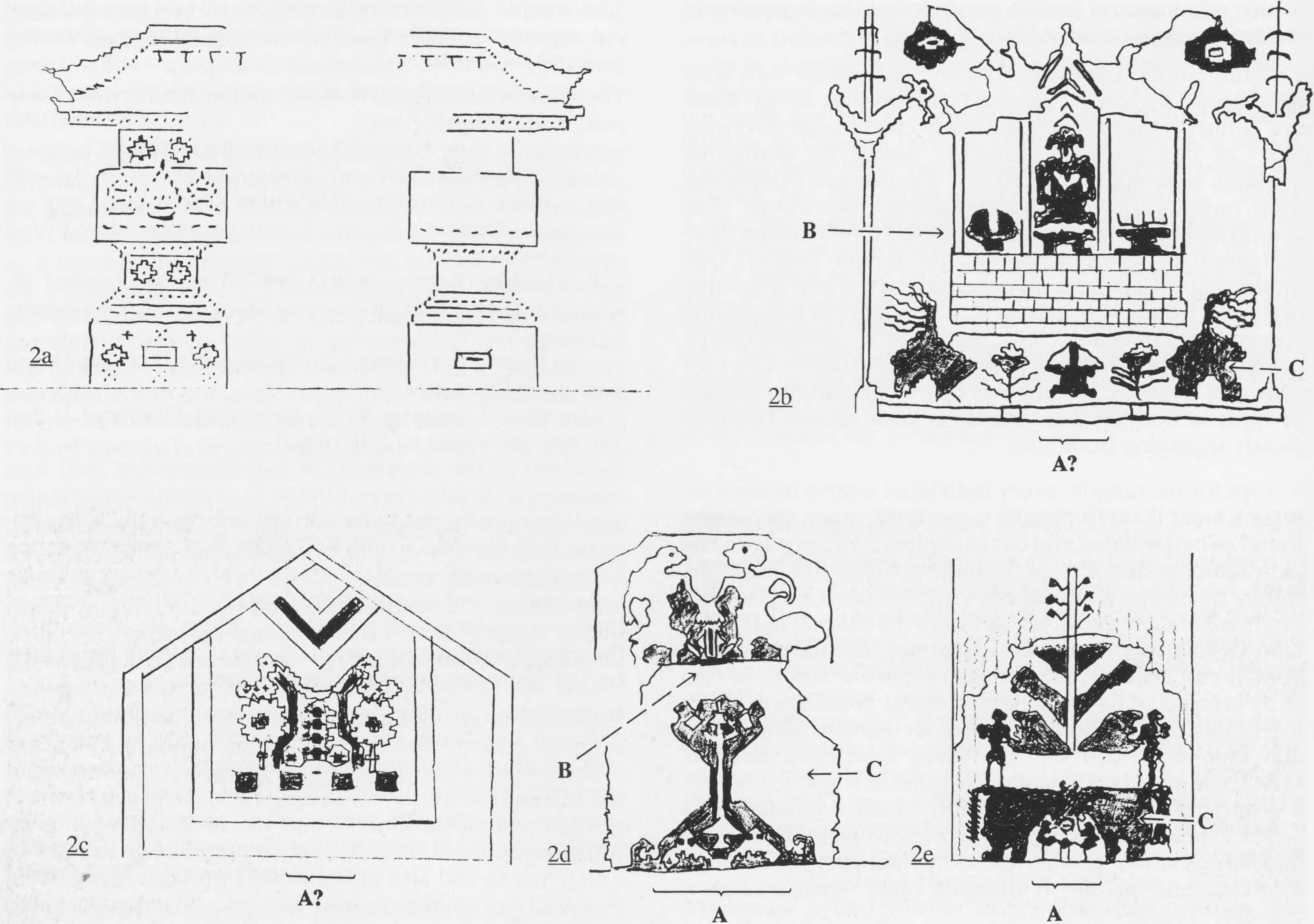 Drawings 2:
a. Balinese geringsing ‘temple’, after Bühler et. al 1975: no. 36
b. Kampuchean weft ikat ‘temple’, Takeo province, early 20th century. After Musée de l’Impression sur Étoffes, Mulhouse, accession no. 954.515.1
c. Gujarati patolu ‘temple’, after Bühler and Fischer 1978: M T 43.
d. Lampung tampan ‘temple’, after Holmgren and Spertus 1980: fig. 14.
e. Lampung palepai ‘temple’. UCLA Museum o f Cultural History, Los Angeles, accession no. X78-444.
Lampung skirts {tapis) bearing ‘red’ warp ikat – newly-documented, and extraordinarily beautiful – greatly expand the recognized inventory of geringsing-related patterns. These tapis display, in their ikat panels, all of the geringsing Bali red geometric/floral patterns, together with many other ‘patola-influenced’ geringsing-like designs for which no geringsing Bali or patola counterparts still exist. From this circumstance we deduce that:
the pattern inventory of the original group of prototype textiles was formerly much larger than that preserved in extant geringsing Tenganan;
in color and design, all of the red geringsing Bali patterns look like plausible patolu patterns – a possibility strengthened by their occurrence in Lampung also (some geringsing Bali patterns are known patolu patterns);
Balinese geringsing most likely copy prototype textiles that enjoyed broad circulation in the Hindu-Buddhist world (of which Bali was, and remains, a rustic minor part); and
the geringsing chintz Color Plates 2a/b points clearly to a patolu model or prototype (narrow red outlines; stepped ▚ double-ikat patterns).
New patola ‘Motif Types’ found mainly, again, in Sumatra (rather than Java, Bali, or India) represent the best possible evidence that the total inventory of patola patterns circulating in the pasisir world was once considerably greater than Bühler and Fischer record in their benchmark 1979 catalogue (see Holmgren and Spertus 1991a, in this volume). Bearing in mind our caveat concerning the importance of evidence which has disappeared, we suspect that anciently the number of patola designs circulating in southeast Asia was much larger than surviving specimens indicate (and included, for example, the geometric geringsing patterns now ‘lost’ in patolu form). Many chintz represented low-cost popular versions of such elite, expensive trade textiles as patola.
Geringsing in its basic form (Color Plates 2a/b and Figure 1) is a type of ceplok, seen in relief at Candi Singosari (early thirteenth century), but also – identically – in Iraq circa second century AD. Its essential bone structure is ancient: possibly not Asian at all, but classical (Mediterranean, Near Eastern) in origin. This accumulation of evidence tends toward a conclusion that the non-wayang forms of Balinese geringsing derive from patolu.
Stylistically, Lampung chintz are extremely close to Cirebon. Indeed, at the end of the eighteenth century Cirebonese batik and Indian chintz were produced in tandem and mutual imitation, as contemporaneous examples show. One startling fact is that the quality (technical and artistic) of Cirebon batik from this period, as testified almost uniquely by the Resink-Wilkens collection at Museum Kraton Sono Budoyo (Yogyakarta), is incomparably higher than the Indian. Several background factors pertain to this impression. Early Cirebon batiks were apparently hand-made – by men, not women – in small numbers for an elite clientele. Patterns of Indian, Chinese, Javanese pasisir and pedalaman, and Sundanese origin blend with utmost ease, reflecting Cirebon’s melting-pot situation (its reputation as a center of artistic and spiritual exploration attracted talented craftsmen). Drawing and dyeing approach the delicacy, complexity, and expressiveness of miniature painting or wayang bébér purwa.
Cirebon’s oldest and best pieces emanate an inspired, metaphysical quality never again matched in Javanese batik – to the great disquiet of many who love and accord precedence to central Java and soga mystery. Most Indian chintz of this period, on the other hand, are block-printed (at least in part) and roughly-drawn on inferior cotton cloth; as previously noted, the preponderance of these chintz were targeted at the low end of the marketplace – in short, most Lampung chintz are cheap and blatantly commercial, compared to the best kalamkari (hand-waxed or -drawn) productions of this and earlier (e.g. Golconda) periods. (However, there are exceptions, such as Color Plate 8 from the Coromandel coast, of remarkable fineness and quality, which affirm that a discriminating elite market still existed.)
Lampung chintz of geringsing type have an obvious formal connection with courtly dodot waistcloths. A scroll from the best and arguably oldest of Java’s antique bébér sets, at Wonosari, depicts men wearing dodot bearing geringsing patterns.
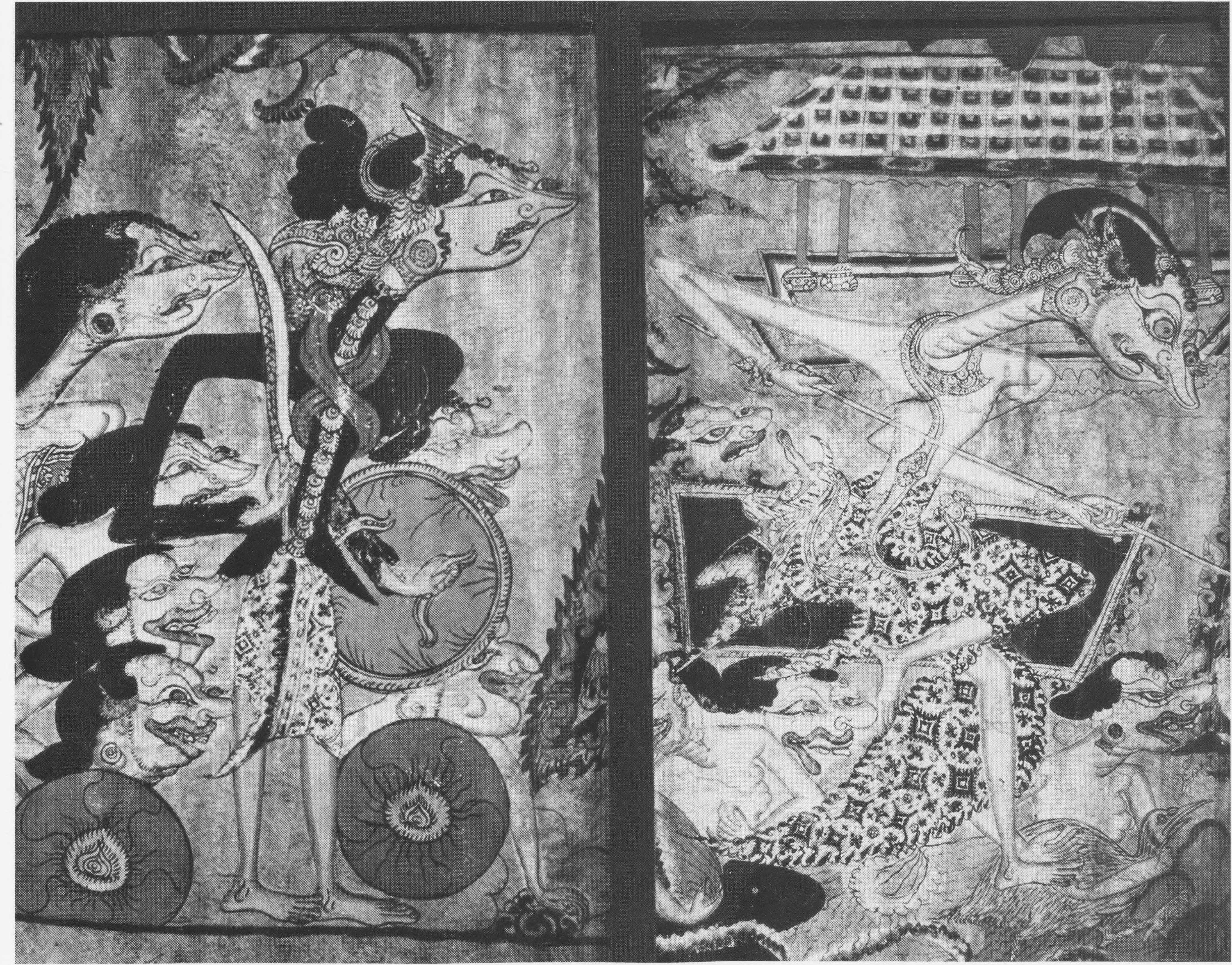
Figure 2 shows two Wonosari details: the garment of the figure at left bears a chintz/batik papan-tumpal pattern on the border, which means that the painter intended a dodot or kain panjang, not a geringsing Bali; the detail at right displays a full field of geringsing pattern. Wonosari and other (Pacitan, Leiden, Giring/Gelarang) bébér are themselves obvious pasisir productions (or at least copies circa 1750-1825 of earlier pasisir originals); they were probably secreted in the desolate hills south of Yogyakarta and Surakarta for safekeeping during the Java Wars 1825-1830. Bébér furnish a trove of information concerning ancient pasisir costume and custom.
Modern field reports from Lampung suggest that Lampung chintz were (and occasionally still are) utilized in the local context as wall hangings or canopies, positioned during ceremonial events behind important personages (e.g. as backdrops for pepadon thrones) or above a pavilion. Lampung textiles (tampan,tapis) depict men of rank wearing voluminous waistcloths identifiable, probably, as dodot. Oddly, we have no ethnographic report from Lampung that chintz were worn (as tampan imagery and dodot usage lead us to expect.) But Indian arts, classical Indonesian sculpture, and bébér (among many other material expressions) offer an alternate antecedent not connected with apparel: the textile backdrop behind enthroned deities, an ancient Hindu-Buddhist iconographic convention observed throughout Indianized Asia.
In Indonesian sculpture, the backdrop pattern is usually floral and/or geometric. A thanka painting from Tibet dated AD 1474 represents the convention in the Himalayas (Figure 3; a detail of one corner of the backdrop is reproduced).
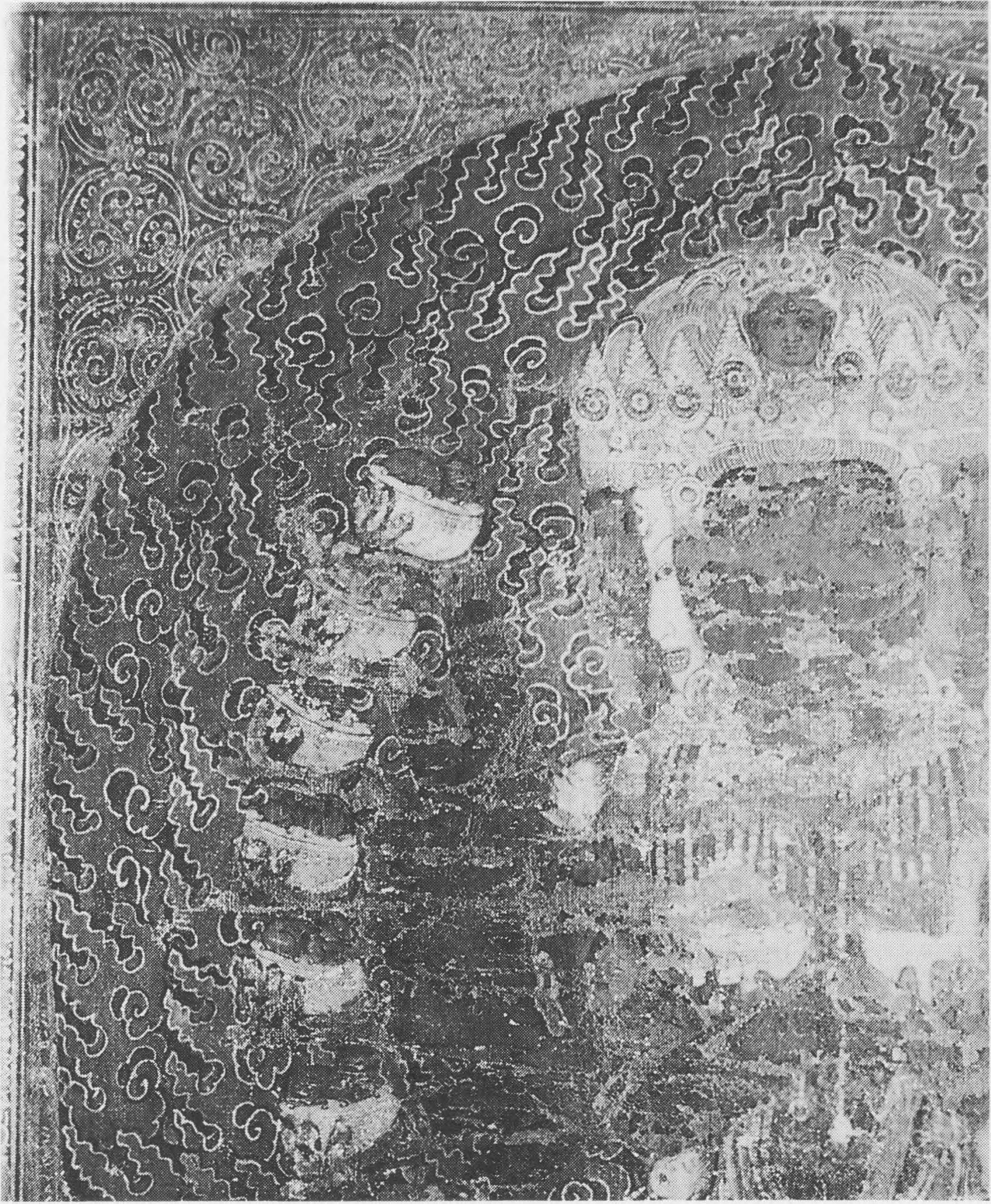
Surrounded by an outer border pattern of circular floral arabesques in classic chintz style, an inner ogival backdrop of ‘flame’ occurs (derived from prabhamandala halos, which indicate “the gods’ luminous nature”). These flames resemble parang batik patterns, and are contained within an oval halo similar in shape, scale, and placement to the present geringsing chintz Color Plates 2a/b. In Java parang-like motives that surround a white-centered ogival or octagonal textile (e.g. kain kembangan shawls, or big dodot) are called cemukiran or modang (also, in the Principalities, kerissan and kumitiran). Cemukiran is one of the forbidden Yogyakarta patterns; kumitir derives from kitir, meaning “quiver, tremble, sway to-and-fro” – old wordlists describe kitir as “spangles of thinly painted silver or gold; trimmings or chiffons hanging down from a Balinese kite”, “a single leaf which trembles in the wind.”
Only in painting is the flower-flame backdrop convention illustrated in satisfying, recognizable detail. Central Asia and India offer many examples much earlier than Tibetan thanka Figure 3; they clarify the evolution of this idea, from pure flaming nimbus – its original meaning – to an elaborate backdrop setting for gods. For example, a wall painting from Kizil (AD 600-650) displays kain kembangan-type pennants (like tritiks in the Principalities) flying from stupa pinnacles. At Bezeklik (eighth-ninth century) near Turfan, another wall painting shows Buddha with both nimbus and prabha composed of “coral-like cloud-scrolls … shaded from dark along the centre of each scroll to nearly white at the edges” (a coloristic signature of early Cirebon batik); blossoms sprinkle the surround, which is crowded with devatas and Bodhisattvas. A Tang-period silk-painting from Dunhuang, very Chinese in appearance, displays numerous Buddha and Bodhisattva figures; inscriptions in Chinese characters on this silk state that “the figures were intended to reproduce sculptured images worshipped at various places in India” [our emphasis]. Here, the flower-flame combination adopts an oval shape identical to that of some Lampung chintz (e.g. Color Plate 1); flowers and flames are both chintz-like; most striking, the size of the chintzy backdrop, in proportion to the standing god, is roughly that of Lampung pieces – in other words, the ‘lifesized’ god might be positioned in front of a latter-day Lampung chintz. At Ajanta too, kerissan flames appear both outside and inside the Bodhisattva’s nimbus. Many other paintings, bronzes, etc. feature a narrow arching prabhamandala emitting flame from both the outer and inner edges; compare the chintz/batik practice of depicting parang radiating (e.g. from the oval shape of Color Plates 2a/b, or from a kepala) in opposite directions, both inward and outward.
The suggestion that parang patterns represent flame, inspired by prabhamandala, seems more plausible than other explanations (e.g. Loebèr’s notion of bird beaks, or Bosch’s “arabesque derived from the rootstock of the lotus”). Wei-period sculpture frequently depicts prabhamandala flames that look like keris blades, even to the crosspiece and wavy pamor. In another odd patola-chintz intersection, a very late Keralan (southwest Indian) wall painting displays Narasimha enthroned, against a patolu backdrop – not merely patolu patterns, but an actual textile with old-fashioned patolu side borders similar to Holmgren and Spertus 1991a: pl. 5, and mainfield and end panels of a ‘lost’ pattern type. This is proof, albeit of eighteenth-century date, that throne backdrops were conceived as textiles (specifically, as members of the chintz-patola complex of textiles) in at least some localities. The ancient Narasimha (Vaishnavi ‘Man-Lion’) cult was patronized by kings and warriors.
Flowers depicted above/behind a throne, or surrounding its canopy, spread to every corner of Asia via the conventionalized image of Buddha preaching beneath the Bodhi tree. In the earliest Indian narrative sculpture (Bharhut, Sanchi), the tree symbolized Buddha, Who was never represented (in Jataka, passers-by mistake Buddha, seated under the Bodhi tree, for a tree-god who has climbed down). Sometimes (e.g. Sanchi) the tree produced large fruits. Although Buddhist aniconism softened over time, and the corporeal Buddha came to be enthroned in increasingly elaborate architectural settings (mainstream Hindu fashion), the Bodhi tree persisted, prominent somewhere in the scene (e.g. around the canopy, often engulfing it in foliage), its fertility suggested in a spilling of leaves and flowers, or fruits hanging pregnantly.
In short, the formal organization displayed in Lampung chintz seems to occur (elsewhere) at an early date (although we have found no very early instance of the actual geringsing pattern itself). The point is, that Indonesia and central Asia reflect separate developments of conventions which were originally and specifically Indian. They are not identical, but they are close enough to indicate a common origin. In absorbing the Tree of Life into its essential iconology, Buddhism put to service a religious idea that was virtually universal among early peoples, and which facilitated its reception in Indonesia.
Many apparently India-made chintz were designed specifically, and only, for Indonesia. They had no recorded Indian domestic popularity, they were not reproduced in Indian sculpture or painting (except arguably in Jain painting), they are not found in India today but only in Indonesia, and often they are not remembered in India, either by craftsmen, collectors, or scholars. Wise Indian art historians look at them politely and acknowledge Indian technology, dyestuffs, and iconographic features – but they do not ‘recognize’ these objects on an intuitive level as genuine offspring of the Indian cultural milieu. They are, in short, surprised and perplexed; they sometimes ask, “Could these not have been made elsewhere – in Indonesia?” Their curiously detached reaction contrasts with the profound grip which these Indian textiles exerted on the Indonesian imagination. It is a deep enigma, and we propose only tentative solutions.
Lampung chintz could be ‘offshore’ imitations, made in southeast Asia. We consider this unlikely, however, because Lampung chintz conform in all major respects to known Indian characteristics. It is not clear whether dye analyses would definitively establish their provenance. If offshore chintz workshops did exist, perhaps established by non-Indonesians using Indian manufacturing methods to exploit blatant commercial opportunities, the resulting product might be almost indistinguishable from ‘genuine’ chintz. But regardless of where these textiles were made (Gujarat, Bengal, Coromandel, or ‘offshore’), it is the Indonesian predilection for the type that matters.
Which returns us to the horse-and-cart question of where and how this Indonesian-Indian symbiosis started. The Indonesia-centric proposition is that either or both double-ikat and chintz/batik were originally Indonesian inventions, usurped at some point by Indians, who commandeered the market due to superior technology (facility with silk, fast colors, rationalized ‘industrial’ methods of manufacture, etc), and repatriated a preferable product to Indonesia (but without necessarily causing Indonesian production of these or related types to cease entirely). According to this hypothesis, batik and geringsing are ancient relics. The contrary opinion is that almost all sophisticated Indonesian textile techniques, genres, and iconography were imported – from China, India, Persia, the Near East. The centrist attitude is that these resist techniques may well be independent developments, utilizing unrelated tools (canting vs. kalam) and stuffs (cotton vs. silk, cold vs. hot dyes), but enjoying extensive iconographical cross-fertilization.
If we posit a considerable age for the founder prototypes, circa 300 BC – AD 900, many theoretical difficulties are resolved. During this period, two great cultures launched vast international dispersions – the Austronesian [Indonesian] to the southern oceans and the Indo-Scythian [Indian] to the north – which reached and recognized the boundaries of Asia, established political and cultural interrelationships between its many parts, and planted seeds of continental awareness. Similar movements of people and/or ideas had happened in prehistory (for example, during what Heine-Geldern called the “Pontic migrations”) and they would occur again (Goths, Mongols, Europeans; Islam, Christianity) – but the scope and sustained consequences of these Indian and Indonesian outbursts set them apart.
From India, powerful ideas were disseminated by relatively few people. In the last centuries of the first millennium BC, Indian art was fertilized and stimulated by Near Eastern and Mediterranean cultures; in return India sowed its ideas in central Asia and in Persia: Religion, mainly Buddhism, was the motive force behind Indian influence, from Scythia to Japan; only in southeast Asia did Saivism sometimes better serve the charismatic ‘big man’ rulers from whom communal fertility flowed, and populations who worshipped the power inherited from ancestral clan founders. Earlier still, circa 3000 BC, Austronesian peoples began a spread that ultimately embraced 60% of the globe in equatorial regions, from Taiwan to at least the east African coast, and across the Pacific. Although primarily a massive, gradual extension of population, in the western Indian Ocean it may have been fueled by trade considerations (possibly as early as the first millennium BC).
Apart from Indian Ocean littoral regions, the only place where Austronesian peoples and Indian ideas intermingled was southeast Asia. A remarkable cultural fusion (Sa Huynh/Dong-s’on) arose in the southern borderlands of China during the period 600 BC-AD 500, which assimilated iconography from most of the known world into its art, including Steppic, Chinese, Austro-Tai, Middle Eastern, Mediterranean, and Indian elements, and became a crucible for subsequent southeast Asian culture.
Bühler’s “hypothesis of Chinese origin” proposes that tribal people of south and southwest China were the first to make batik and other resists. The superficial attraction of this hypothesis, at least for Indonesia, lies in iconographic affinities between this border region and ‘Old Indonesian’ patterns (e.g. batik in Toraja, Sunda, central Java). But the theory also rests largely on circumstances (e.g. the greater age of Chinese examples), assumptions (that the rich array of Chinese resist traditions reflects a physical nearness to the sources of these techniques), near-sighted testimony (in “old Chinese [texts that] these [southern tribal] people knew batik before they came under Chinese influence”), and inferences (that Han Chinese then ‘exported’ resist-patterning techniques elsewhere via the Silk Road). Technique and iconography are separate matters.
Bühler’s proposal is still plausible – assuming that resist techniques were not invented independently but spring from one region, and that the scant body of (mainly archaeological) evidence is deemed sufficient to draw conclusions. However, there is so much lost evidence that a single discovery could overturn the hypothesis. For example, the Niya fragment (page 60 above) is uncomfortably close in date to the opening to the West of the Silk Road, and exceedingly distant in iconographic terms from tribal southern Chinese ‘precursors’. Early pre-Columbian resists either prove that independent invention is possible (which at best narrows the applicability of the hypothesis, and may moot it), or else – if pre-Columbian occurrences reflect Asian-American contact – then they are much older than any extant Asian evidence and thus beg a host of new questions, more pertinent to Austronesian peoples (the only voyagers in the Pacific at those dates) than to Chinese. Indeed, in a single-source scenario these techniques might have been introduced from Indonesia, from the Caucasus or Egypt, from India or Mesopotamia.
In short, the technical origins of chintz and batik are not yet known, and may be unimportant. Donor-recipient analysis of iconography is more revealing, because complex patterns are much less likely to be independently invented than technical processes. The early first millennium AD Indo-Sino-Austronesian-Tai ‘fusion culture’ in southeast Asia spawned clear iconographic connections in textiles, and the additional presence of Indo-Buddhist influence and of central and west Asian elements is unquestionable. A common denominator in the geographical distribution of early pasisir-style textile iconography is a Buddhist past or present, from the south China borderlands, to the islands of west- and central-Indonesia. This is a separate discussion; but in sum a common iconographical language, obvious in parallels between Bhutan and Batakland, or Lampung and Laos, spread in the train of Buddhism. The Hellenized Indo-Scythian Kushan dynasty, which actively proselytized Buddhism, probably played a major rôle in this dispersion of ideas. Seeds it planted in central, east, and southeast Asia were reinforced after the sack of Nalanda and cutting down of the Bodhi tree at Gaya circa AD 655, which portended the decline of Buddhism in India. Throughout the turbulent seventh century, faced with Hindu persecution, Buddhist monks migrated to the Himalayas and central Asian oases, and across the sea. Almost immediately, major Buddhist kingdoms appeared in the western Malay archipelago, and celebrated their importance with monumental building projects of great stylistic maturity.
Some of the textile patterns most popular in southeast Asia during later centuries were probably synthesized, in this general region, during the period 300 BC-AD 900. Bidak Komering (Plate 5), with their tightly packed angular patterns, 5-scrolls and long hooked lines, small sprightly animals and anthropomorphs (Drawings li- lk, lm), organized around large formal lozenges, illustrate this fusion of tribal and classical ‘high-culture’ elements. These bidak are pertinent on the one hand to e.g. Iban warp ikat with its Dong-sonian features or perhaps to the fully-patterned ground of some central Javanese batik designs, e.g. semen or udan liris, and on the other to the sweeping arabesques of Palembang weft ikat and the stately metricality of classical west Asian and Indian patterns.
It seems likely to us that early southeast Asia was the cradle of fusion pattern types that shaped regional tastes. Those patterns were subsequently made for southeast Asia primarily, but often manufactured elsewhere. The superior products of India and China probably rapidly displaced any preexistent local batik tradition and relegated it to an obscure secondary rôle, until it resurged in the eighteenth century in a specifically Islamic environment. But, in fact, we see only scant evidence that there was a ‘pre-existent batik tradition’. The fundamental absence of batik outside Java is striking. Bali and Lampung ignore it; Jambi batiks are obvious chintz facsimiles (cf . Palembang sebagi, old one-sided batiks that display limar-like patterns and are locally acknowledged as copies of chintz); simbut tulis and sarita may be ancient remnants but may also be merely provincial derivations of trade textiles. Amid an astonishing proliferation of weaving techniques, there are so few signs of batik in the archipelago. Weaving has clear precedence; batik appears to have arisen later, in deliberate distinction or even rejection to weaving.
Chintz held a special place in Indonesia. It seems possible (in our opinion, virtually certain) that chintz was the inspiration, precursor, and iconographic model of Javan and Sumatran batik as we know it from extant examples. Although as difficult to define as the meaning of the term cinde (variously chintz, patola, or silk weft ikat), we sense that patola and chintz were somehow interrelated. Colonial- period history treats them both as trade goods; but it is likely that originally they dispersed among southeast Asian peoples in a more compelling, i.e. religious, context.
Fundamental differences between Indian and Indonesian tools and technology shape our opinion that most Indonesians did not learn to make batik under direct Indian tutelage, but rather mastered on their own initiative an art of chintz facsimile, which reproduced foreign and ‘fusion’ iconography but used tools of Indonesian invention. Although batik in some primitive form may have been a feature of ‘Old [Austronesian] Indonesia’ (see note 7), we suspect that its full development in Indonesia may be very late – as late even as the eighteenth century – whereas chintz was probably present in the archipelago much earlier, in the first millennium AD. Modern practice in Toraja and Lampung suggests that during Hindu-Buddhist times chintz may have been worn only sparingly or not at all, but rather used ritually, treated as grave goods (cf. Fustat), or hung as ceremonial curtains and canopies. Feudal sumptuary restrictions may have applied to chintz, much as they did to patola. The dramatically increased affluence and democratization of Islamic pasisir society probably made chintz available to a much larger segment of society, which embraced this formerly inaccessible (or forbidden) finery as dress, but also thereby hastened its commercialization and secularization. The reported leading rôle of Chinese in Malayan cinde manufactories (note 85) presages their control of the batikkerijen, and helps to explain the presence of Chinese motives in batik iconography of the late, historical period.
One salient aspect of chintz in Indonesia is, generally speaking, its mediocre-to-poor quality. Surviving pieces represent the declining end of a tradition. Considering the highly refined Indonesian eye for excellence, it seems very likely that ulterior factors were operating among Indonesians in their continuing demand for chintz even as quality slipped, probably imperceptibly, over centuries of cut-throat competitive trade. Conservative Javans retained an adat/religious/historical attachment to the chintz-patola complex of cloths. Even today, the central Javan attitude is awed, protective, and mystic. Progressive Muslims no longer shared these feelings; they wore these cloths as a conspicuous visual declaration that new people were in power, and that old cultural rules and entitlements had changed. But apart from its symbolic value, for Muslims batik was merely decorative. Little wonder that inner chintz/batik qualities disappeared, that craftsmanship collapsed, or indeed that traditional Javanese conservatives resent and despise pasisir batik.

The Javanese preference for brown-reds (i.e. soga, from the bark of Pelthophorum pterocarpum) may represent a striving for the same brown-red color value remembered by geringsing. In the Javan color spectrum, ‘brown’ (and soga) are considered shades of red. Although no known patola precisely reproduce the soga tone, very old patola exhibit an antique dark Turkey-red color, distinctive and venerable (e.g. Holmgren and Spertus 1991a: pl. lb). Other old patola display a glowing orange-brown identical to bidak Komering (Color Plate 5). The minimum conclusion is that the patola palette, like its iconographic inventory, was formerly more wide-ranging; possibly it included a red so dark that it passed into soga-brown. Many Fustat and Toraja chintz manifest a flat red-brown. Soga/geringsing/bidak/cepuk color values may reflect a deep cultural partiality originally shaped by foreign products.
Sumatran bidak Komering indicate that, whatever their origin, geringsing-like patterns once circulated widely. Javanese literature says so too. And as noted before, all red geringsing Bali patterns appear in Lampung tapis, together with many additional (but generically related) patterns of matching complexity and sophistication. Skirting the ongoing reservation that geringsing in Javanese literature may not be identical with geringsing Bali, we posit instead an ancient group of western Indonesian patterns which generally looked like Balinese geringsing: not exactly the same – often more complicated iconographically, and much finer than geringsing Bali in the best examples – but essentially akin.
King Kertanagara’s expedition to Sumatra in 1275 and his conquest of Bali nine years later represent the first real efforts of Singasari-Majapahit to control foreign countries. Javanese influence subsequently intensified in Bali, and from this event may also date a switch in Lampung from a Sumatran-pasisir cultural and political perspective to one more narrowly Java-oriented. In our view, the common opinion – that Bali and southern Sumatra reflect the art of old Java before Islam blew out the center and left only scattered peripheral pieces – only applies clearly to a few relatively late textile types, e.g. geringsing wayang and Kalianda tampan. Other textile types appear to pertain to a cultural environment shared throughout western Indonesia, in which the Javanese contribution is not especially pronounced. Until we know what, for example, Srivijayan painting or architecture looked like, we are wary of concluding that Indonesian arts are derived from Java simply because Javanese examples are the only ones which still exist. We imagine that if we chanced upon troves of representative seventh century Srivijayan and Javan textiles, Indonesian textile history would be substantially revised.
It seems clear that Balinese geringsing wayang were influenced by thirteenth-fourteenth century east Javanese Majapahit sculptural iconography; but chintz, bidak, and cepuk do not display these signature figural motives. Thus, geringsing wayang are probably limited local variants rather than core elements of the geringsing pattern family – the idiosyncratic product of a single ‘specialist caste’ charged with a ritual-textile making function, and hence not reproduced by other weavers who worked with geringsing patterns in the broader sense. Tenganan Pegeringsingan’s tight communal organization, its separate stature in Bali, the 5- 8 year ritual of making a geringsing, intriguing genetic data that suggest an ancestral connection with India, their own notion that they came (“shipwrecked”) from Java (= ‘overseas’?), and other singularities altogether strongly indicate that this community is an ancient entity, possibly transplanted intact from an earlier homeland (cf. the Badui). The function they fulfill today, as suppliers of special geringsing products throughout Bali, may once have been performed over a much wider area (Java +), and even from a different venue. A similar ‘corporate’ organization was in fact the long-standing Indian model for textile production, and artisan communities existed in Majapahit also (there are still many such communities in Bali). Indian weavers claimed divine descent. They enjoyed high stature, special religious privileges (e.g. the right to blow the conch-shell), large land grants, and “a fairly prosperous position, [particularly] those who catered mainly to the temple and court and specialized in the finer varieties of cloth.”
The most archaic Indonesian textile genres are also, often, the most intricate technically – as Bali, Toraja, Borneo, and other island cultures testify. Double-ikat is the epitome of technical complexity; and because sericulture was a relatively late arrival in southeast Asia, it is conceivable that the first double ikats were cotton: an Indonesian origin for the main geometric geringsing patterns remains a polite possibility. However, India was famous for cotton in classical times (Sanskrit karpasa, “cotton”, passed into Latin as carbasina around 200 BC). Silk was woven in India by the early first millennium AD. First century BC-AD sixth century Indian texts speak of huge silk and cotton wholesale marketplaces (the Porunararrupadai mentions a textile bearing “such delicate patterns as to make it look like ‘the slough of a snake’”).
In our view, the evidence indicates that geringsing patterns originated in trade textiles (prototypes) in general southeast Asian circulation. Probably those prototypes came from India, and either arrived first, or enjoyed their greatest popularity, in double-ikat form. To which we add our impression, ‘inadmissible’ perhaps as evidence, but nonetheless fundamental, that mainstream geringsing patterns (Color Plates 2a/b and Figure 1) look Indian, to their core. We see no sign whatsoever of Austronesian iconography.
We have discussed only one of the abundant surprises concealed in Lampung chintz. Many other patterns usually considered to be quintessentially Indonesian (or China-flavored) also occur among these Indian textiles. For example, one Lampung chintz (Color Plate 4) depicts animal creatures strongly reminiscent of Balinese paintings, wayang, old Javanese wood sculpture, and real-life ceremony (e.g. kuda lumping). The alas-alasan chintz (Color Plate 3) is another revelation: a pattern associated essentially and deeply with Java. Color Plate 8 illustrates a chintz that verges upon batik format (other Lampung chintz, slightly more recent than those reproduced in this article, adopt the modern kain panjang format in its entirety). This is evidence that ‘idiosyncratically Javanese’ batik iconography was once reproduced in India on trade items that are dated substantially earlier than any surviving batik counterparts from Indonesia. It is evidence that compels, finally, the basic question implicit to our discussion: How much of this iconography is originally Indonesian?
Some – but not nearly so much as pretended. Mainly, it is a matter of flavor; Indonesia’s textiles are far more Indonesianized than its classical Hindu-Buddhist bronzes (which are Indian in main features, but tuned to a distinct Indonesian sensibility). However, among sophisticated, iconographically elaborate Indonesian textiles, almost all core iconography was borrowed. This is demonstrable in one area after another, from Aceh to Timor. The exceptions, patterns that are probably of Austronesian origin, prove the rule: orant human figures and reptiles, zig-zags, diamonds, spirals, or the simple zipper-striped ikat textiles of eastern Indonesia. Even early Steppic designs like interlocked ‘genealogical patterns’, or the Zhou/Dong-s’on patterning of Iban and Mindanao ikat, or the black ikat seen on Lampung tapis (to which bidak Komering closely relate), represent early borrowings, albeit very ‘close to the bone’ of Indonesian art – so old that they have been ‘naturalized’ in Indonesian culture.
Indonesia’s special contribution lies elsewhere. It is not merely a matter of alterations to materials, scale, harmonics, and the timbres of dyes; of nuance and impact. Neither does it matter whether Indonesian textiles recall “original significations” surrendered and lost by Indians in their commercial environment, or obsolesced in the waning of religions and eras. Indonesians reintroduced sincerity to the cloths and meaning to their patterns; they re-animated de-sacralized imagery and objects with new spirits and ecstatic qualities. Old Indonesian textiles grip and move us: a crucial difference, compared to the dry commercial offerings of India (or of contemporary Indonesia itself). We perceive directly in the best early home-made/home-use Indonesian textiles that the weaver has invested feelings deep in herself, reflecting the convictions of her culture. Often even the humblest weavings communicate and persuade, precisely because they are convinced works of religious inspiration – an age-old trait of great art, both East and West.
Rabindranath Tagore, To Java, from the Pilgrim from India
(verse composed during a journey to Java and Borobudur, and translated from the original Bengali)
In a dim, distant, unrecorded age
we had met, thou and I, -
When my speech became tangled in thine
and my life in thy life …
Thy beckoning call blended with the conch-shell sound
that rose in worship at the shrines by the sacred waters of the Ganges.
The great God Vishnu spoke to me,
and spoke Uma, the ten-armed Goddess:
“Make ready thy boat, carry the rites of our worship
across the unknown sea.”
The Ganges stretched her arm to the Eastern ocean
in a flow of majestic gesture.
From the heavens spoke to me two mighty voices -
the one that had sung of Rama’s glory of sorrow
and the other of Arjuna’s triumphant arm, -
urging me to bear along the waves
their epic lines to the Eastern islands …
Dawn scattered her prodigal gold
on the path of our meeting
along which the two companion souls
combined their journey through ages
among a crowd of gigantic visions.
The time wore on, the dark night came upon us,
and we knew not each other.
The seat we shared was buried under the dust
raised by Time’s chariot wheels.
By the receding flood of oblivion I was borne back
to my lonely shore …
Thy call reaches me once again
across hundreds of speechless years.
I come to thee, look in thine eyes,
and seem to see there the light of the wonder
at our first meeting in thy forest glade,
of the gladness of a promise
when we tied golden threads of kinship round each
other’s wrist.
That ancient token, grown pale,
has not yet slipped off thy right arm,
and our wayfaring path of old
lies strewn with the remnants of my speech.
They help me to retrace my way to the inner chamber of thy life
where still the light is burning that we kindled together
on the forgotten evening of our union.
Remember me, even as I remember thy face,
and recognize in me as thine own
the old that has been lost, to be regained and made new.
Batavia, 21 August 1927
Color Plates 1-8 (Article Geringsing)
Photography: Plates 1, 3, 8 by John Bigelow Taylor; Plates 2a/b, 5, 6, 7 by Christopher Gardner, Yale University; Plate 4 and Figures 2, 4 by R. J. Holmgren
1. Chintz with dentate oval center. 266 x 204 cm.
2a. Chintz with geringsing pattern. 322 x 225 cm.
2b. Detail of Color Plate 2a.
3. Chintz with alas-alasan design. 264 x 211 cm.
4. Detail of chintz with animals. Probably Coromandel coast, southeast India. Pounced designs. Size of complete textile: 330 x 236 cm. Approximate area of detail: 117 x 80 cm.
5. Detail of funerary shroud (bidak); cotton weft, silk warp, and gold gimp; weft ikat; Komering Ilir, north Lampung area [South Sumatra Province], probably eighteenth century. Size of complete textile: 240 x 93 cm. Approximate area of detail: 55 x 59 cm.
6. Fragment of ceremonial textile (cepuk) with geringsing pattern, weft ikat of cotton, Karangasem area, east Bali, nineteenth century. 120 x 81 cm.
7. Detail of ceremonial textile (cepuk) with ‘temple’/house, weft ikat of cotton, Karangasem area, east Bali, nineteenth century. Size of complete textile: 217 x 64 cm.
8. Chintz with white rectangle edged in fine tumpals. 265 x 165 cm.
Abdurachman, Paramita, and Lisa Singh 1988. Cindai. Pengembaraan Kain Patola India. Jakarta: Himpunan Wastraprema
Adams, Monni 1971. “Designs in Sumba Textiles: Local Meanings and Foreign Influences.” Textile Museum Journal III no. 2 (December): 28-37. Washington.
Andrews, Fred H. 1948. Wall paintings from ancient shrines in Central Asia, recovered by Sir Aurel Stein. Text and plate-portfolio volumes. London: Oxford.
Bellwood, Peter 1979. Man’s Conquest of the Pacific: The Prehistory of Southeast Asia and Oceania. New York: Oxford University Press.
Bernet Kempers, A. J. 1959. Ancient Indonesian Art. Amsterdam: C. P. J. van der Peet.
Bezemer,T. J. n.d. [circa 1931]. Indonesische Kunstnijverheid/Indonesian Arts and Crafts. Den Haag: special publication of the periodical “Nederlandsch-Indië Oud en Nieuw”.
Binney, Edwin, 3rd 1973. Indian Miniature Painting from the Collection of Edwin Binney, 3rd: I. The Mughul and Deccani Schools. Portland Art Museum.
Brown, Percy 1942. Indian Architecture (Buddhist and Hindu). Bombay: Taraporevala.
Bühler, Alfred 1959. “Patola Influences in Southeast Asia.” In Journal of Indian Textile History IV: 446. Ahmedabad: Calico Museum of Textiles.
〜 1972. Ikat Batik Plangi. Reservemusterungen auf Garn und Stoff aus Vorderasien, Zentralasien, Südosteuropa und Nordafrika. 3 vols. Basel: Pharos-Verlag Hansrudolf Schwabe.
Bühler, Alfred, and Eberhard Fischer 1979. The Patola of Gujarat. 2 vols. Basel: Krebs.
Bühler, Alfred, Urs Ramseyer, and Nicole Ramseyer-Gygi 1975. Patola und Geringsing. Basel: Museum für Völkerkunde.
Bühler, Alfred see also Larsen, Jack Lenor, Alfred Bühler, and Bronwen and Garrett Solyom
Chandra, Moti 1949. Jain Miniature Paintings from Western India. Ahmedabad: Sarabhai Manilal Nawab.
Cheesman, Patricia 1988. Lao Textiles: Ancient Symbols - Living Art. Bangkok: White Lotus.
Damais, S. J. H. 1974. Batik. Jakarta: Pertamina/Municipal Committee of PATA ‘74.
Damais, S. J. H ., and Robert J. Holmgren 1992 Wayang bébér purwa: ancient Javanese painting. Forthcoming. [* unpublished]
Dumarçay, Jacques 1987. The House in South-East Asia. Singapore: Oxford University Press.
Elliott, Inger McCabe 1984. Batik, fabled cloth of Java. New York: Potter.
Gao Hanyu 1987. Soieries de Chine. Paris: Nathan. A Chinese-language version bears the English title “Chinese patterns through the ages” (Hong Kong: Commercial Press, 1986).
Gittinger, Mattiebelle S. 1979. Splendid Symbols: Textiles and Tradition in Indonesia. Washington: Textile Museum. Exhibition catalogue. 2nd expanded ed ., Singapore: Oxford University Press, 1985.
〜 1982. Master Dyers to the World. Technique and Trade in Early Indian Dyed Cotton Textiles. Washington: Textile Museum.
Guy, John S. 1987. “Commerce, Power, and Mythology: Indian Textiles in Indonesia.” Indonesia Circle 42 (March): 57-75. London: School of Oriental and African Studies.
Hardjonagoro, K. R. T. 1980. “The Place of Batik in the History and Philosophy of Javanese Textiles: A Personal View”. Trans, and ed. R. J. Holmgren. In Indonesian Textiles: Irene Emery Roundtable on Museum Textiles, 1979 Proceedings (ed. Mattiebelle Gittinger), 223-242. Washington: Textile Museum.
Hartel, Herbert, and Marianne Yaldiz 1982. Along the Ancient Silk Routes: Central Asian Art from the West Berlin State Museums. New York: Metropolitan Museum of Art.
Hartkamp-Jonxis, Ebeltje 1987. Sits, Oost-West relaties in textiel. Zwolle: Waanders.
Holmgren, Robert J., and Anita E. Spertus 1980. “Tampan pasisir: Pictorial documents of an ancient Indonesian coastal culture”. In Indonesian Textiles. Irene Emery Roundtable on Museum Textiles, 1979 Proceedings (ed. Mattiebelle Gittinger), 157-198. Washington: Textile Museum.
〜 1983. “Fresh Indonesian Evidence of Lost Indian Textiles.” Public lecture, The Irene Emery Roundtable on Museum Textiles: The Eastern Hemisphere Textile Trade. September 8, Indianapolis Museum of Art.
〜 1989a. Early Indonesian Textiles from Three Island Cultures: Sumba, Toraja, Lampung. New York: Metropolitan Museum of Art.
〜 1991a. “Newly Discovered Patolu Motif Types: Extensions to Alfred Bühler and Eberhard Fischer, The Patola of Gujarat (1979).” In this volume.
〜 1991b. “Is Geringsing Really Balinese?” In this volume.
Holmgren, Robert J., et al. 1991. Lampung: Art of an Old Indonesian Culture. Forthcoming. [* unpublished]
Holmgren, Robert J. see also Damais, S. J. H ., and Robert J. Holmgren.
Jacquet, Jacqueline Thome 1978. Chefs-d’oeuvre du Musée de l’Impression sur Étoffes. 2 vols. Tokyo: Gakken.
Jasper, J. A ., and Mas Pirngadie 1912. De weefkunst. Vol. II of De inlandsche kunstnijverheid in Nederlandsch-Indië. Den Haag: Mouton.
〜 1916. De batikkunst. Vol. Ill of De inlandsche kunstnijverheid in Nederlandsch-Indië. Den Haag: Mouton.
Khan Majlis, Brigitte 1984. Indonesische Textilien: Wege zu Göttern und Ahnen. Cologne: Rautenstrauch-Joest-Museum für Völkerkunde. Exhibition catalogue.
Kramrisch, Stella 1937. A Survey of Painting in the Deccan. Hyderabad: Archaeological Department H. E. H. The Nizam’s Government.
Langewis, Laurens, and Frits A. Wagner 1964. Decorative Art in Indonesian Textiles. Amsterdam: C. P. J. van der Peet.
Larsen, Jack Lenor, Alfred Bühler, and Bronwen and Garrett Solyom 1976. The Dyer’s Art: ikat, batik, plangi. New York: Van Nostrand Reinhold.
Leesuwan, Viboon [1987]. Thai Textiles: Industrial and Social Development. Trans. Patcharee Pokasamrithi. Bangkok: Amarin Printing Group.
Lerner, Martin 1984. The Flame and the Lotus. New York: Metropolitan Museum of Art.
Loebèr, J. A ., Jr. 1920. “Bamboe-ornament van Nederlandsch Nieuw-Guinea.” Nederlandsch-Indië Oud en Nieuw (Den Haag) 4 (Januari-Februari), pp. 270-288, 293-314.
Matsumoto Kaneo 1984. Jodai-gire. 7th and 8th Century Textiles in Japan from the Shoso-in and Horyu-ji. Kyoto: Shikosha.
Maxwell, Robyn 1990. Tradition, Trade, and Transformation: Textiles of Southeast Asia. Canberra: Australian National Gallery.
Miller, J[ames] Innes 1969. The Spice Trade of the Roman Empire, 29 B.C. to A.D. 641. Oxford: Clarendon Press.
Moreland, W. H., ed. 1934. Peter Floris, His Voyage to the East Indies in the Globe 1611—1615. Hakluyt Society Works 2nd series no. LXXIV. London: Hakluyt Society.
Nabholz-Kartaschoff, Marie-Louise 1986. Golden Sprays and Scarlet Flowers: Traditional Indian Textiles from the Museum of Ethnography Basel, Switzerland. Kyoto: Shikosha.
Nooy-Palm, Hetty 1980. “The Role of the Sacred Cloths in the Mythology and Ritual of the Sa’dan Toraja of Sulawesi, Indonesia.” In Indonesian Textiles: Irene Emery Roundtable on Museum Textiles, 1979 Proceedings (ed. Mattiebelle Gittinger), 81-95. Washington: Textile Museum.
Nouhuys, J. W. van 1925. “Was-batik in Midden-Celebes.” Nederlandsch-Indië Oud en Nieuw (Den Haag) 10 (Augustus), pp. 110-122.
Pal, Pratapaditya 1975. Nepal: Where the Gods are Young. New York: Asia Society.
[Peking] 1973. La Route de la soie. Trans, (from Chinese) J. J. Hedelin. Peking: ditions des objets d’art.
Pfister, R. 1938. Les toiles imprimées de Fostat et l’Hindoustan. Paris: Les éditions d’art et d’histoire.
Pigeaud, Theodore G. Th. 1960-1963. Java in the Fourteenth Century: A Study in Cultural History. 5 vols. The Hague: Martinus Nijhoff.
Pirazzoli-t’Serstevens, Michèle 1982. The Han Dynasty. New York: Rizzoli.
Ramaswamy, Vijaya 1985. Textiles and Weavers in Medieval South India. Delhi: Oxford University Press.
Ramseyer, Urs 1977. The Art and Culture of Bali. Oxford: Oxford University Press.
〜 1983. “Double ikat ceremonial cloths in Tenganan Pegeringsingan.” Indonesia Circle 30 (March): 17-27. London: School of Oriental and African Studies.
Rawson, Jessica 1984. Chinese ornament: the lotus and the dragon. London: British Museum.
Robbins, Carol 1984. Selections from the Steven G. Alpert Collection of Indonesian Textiles. Dallas Museum of Art.
Rogers, Susan 1985. Power and Gold: Jewelry from Indonesia, Malaysia, and the Philipine from the Collection of the Barbier-Muller Museum, Geneva. Geneve: Barbier-Muller Museum.
Rouffaer, G. P , and H. H. Juynboll 1914. De batik-kunst in Nederlandsch-Indië en haar geschiedenis. 2 vols. Utrecht: A. Oosthoek. [Dutch text cited; also German text.]
Rowland, Benjamin, Jr. 1963. The Evolution of the Buddha Image. New York: Asia Society.
Schuster, Carl 1965 “Remarks on the Design of an Early Ikat Textile in Japan.” In Festschrift Alfred Bühler. Basler Beiträge zur Geographie und Ethnologie, Ethnologische Reihe, 2: 339-368. Basel: Pharos.
Schwartz, Paul R. 1956. “French documents on Indian cotton painting: (I) the Beaulieu M S., c. 1734.” Journal of Indian Textile History II: 5-23. Ahmedabad: Calico Museum of Textiles.
〜 1969. Painting on Cotton at Ahmedabad, India in 1678. Museum Monograph no. 1. Ahmedabad: Calico Museum of Textiles.
Seherr-Thoss, Sonia P. 1968. Design and Color in Islamic Architecture: Afghanistan, Iran, Turkey. Washington: Smithsonian Institution Press.
Stein, Aurel 1921. The Thousand Buddhas. Ancient Buddhist paintings from the cave-temples of Tun-Huang on the western frontier of China. Intro. Laurence Binyon. London: Quaritch. Text and plate-portfolio volumes.
Steinmann, Alfred 1939. “Enkele opmerkingen aangaande de z. g. scheepjesdoeken van Zuid-Sumatra.” Cultureel Indië I: 252-256. Leiden: Brill.
〜 1947 “Batiks.” Ciba Review 58 (July). Basle: CIBA Limited.
Stutterheim, W. F. 1937. “De oudheden-collectie van Z. H. Mangkoenagoro VII te Soerakarta.” Djawa XVII nos. 1-2 (Januari-Mei): 5-112. Jogjakarta: Secretariaat van het Java-Instituut.
Tucci, Giuseppe 1949. Tibetan Painted Scrolls. 3 vols. Rome: Libreria Dello Stato.
Varadarajan, Lotika 1982. South Indian Traditions of Kalamkari. Ahmedabad: National Institute of Design.
Veldhuisen-Djajasoebrata, Alit [A. M. L. R.] 1980. “On the origin and nature of larangan: Forbidden batik patterns from the central Javanese principalities.” In Indonesian Textiles: Irene Emery Roundtable on Museum Textiles, 1979 Proceedings (ed. Mattiebelle Gittinger), 201-221. Washington: Textile Museum.
〜 1984. Bloemen van het heelal. De kleurrijke wereld van de textiel op Java. Amsterdam/Rotterdam: Sijthoff/Museum voor Land- en Volkenkunde.
Wilkinson, R. J. 1957. A Malay-English Dictionary (Romanised). Facsimile of the 1923 ed. 2 vols. London: Macmillan.
Wolters, O. W. 1979. “Khmer ‘Hinduism’ in the Seventh Century.” In Early Southeast Asia: Essays in Archaeology, History and Historical Geography, ed. R. B. Smith and W. Watson, pp. 427-442. Oxford: Oxford University Press.
Yazdani, G[hulam] 1930,1932,1946,1955. Ajanta. The Colour and Monochrome Repro ductions of the Ajanta Frescoes Based on Photography. Four parts (text and plates). Oxford: Oxford University Press.
Yoshimoto, Shinobu 1977-1978. Indoneshia senshoku taikei [“Survey of Indonesian Dyeing and Weaving”]. 2 vols. Kyoto: Shikosha.
Yoshioka Sachio 1984. Sarasa no sekai-ten [“World of Sarasa Exhibition”]. Kobe: Municipal Museum.
Yoshioka Tsuneo and Yoshimoto Shinobu 1980. Sarasa no sekai [“Sarasa of the World. Indian chintz, European print, batik, Japanese stencil”]. Kyoto: Shikosha.
Zimmer, Heinrich 1960. The Art of Indian Asia. 2 vols. Bollingen Series XXXIX , 2nd edition. Princeton University Press.
Zoetmulder, P. J. 1974. Kalangwan. A survey of Old Javanese literature. Koningklijk Instituut voor Taal-, Land en Volkenkunde Translations Series no. 16. The Hague: Martinus Nijhoff.
〜 1982. Old Javanese-English Dictionary. In collaboration with S. O. Robson. 2 vols. ’s-Gravenhagen: Martinus Nijhoff.